Datasheet4U Logo Datasheet4U.com

XCL231 - Step-down micro DC/DC Converter

This page provides the datasheet information for the XCL231, a member of the XCL230 Step-down micro DC/DC Converter family.

Description

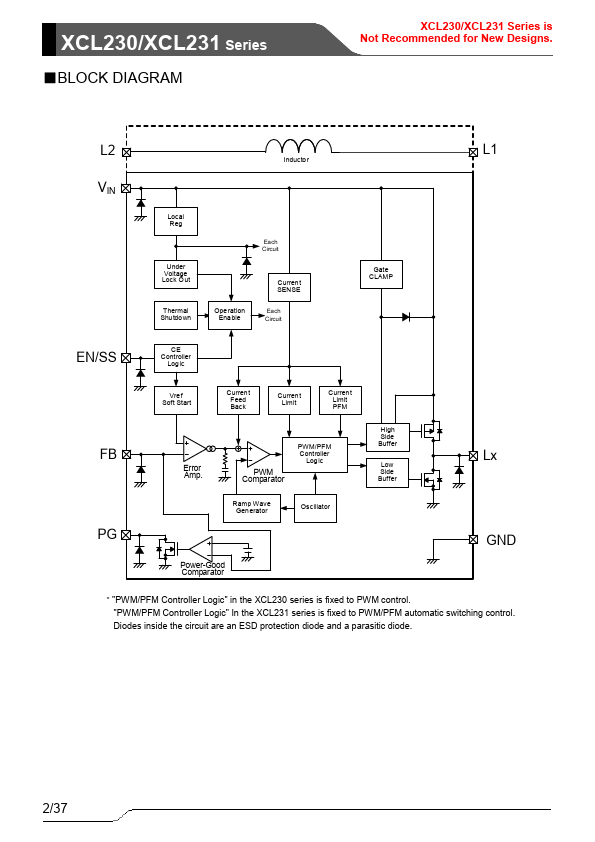
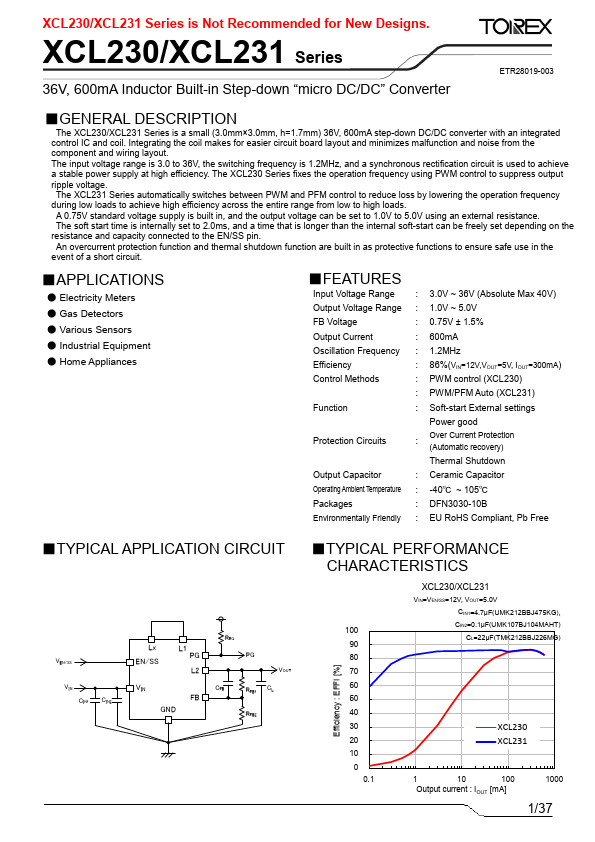
The XCL230/XCL231 Series is a small (3.0mm×3.0mm, h=1.7mm) 36V, 600mA step-down DC/DC converter with an integrated control IC and coil.

Integrating the coil makes for easier circuit board layout and minimizes malfunction and noise from the component and wiring layout.

Features

  • t Voltage Range Output Voltage Range FB Voltage Output Current Oscillation Frequency Efficiency Control Methods Function Protection Circuits Output Capacitor Operating Ambient Temperature Packages Environmentally Friendly : 3.0V ~ 36V (Absolute Max 40V) : 1.0V ~ 5.0V : 0.75V ± 1.5% : 600mA : 1.2MHz : 86%(VIN=12V,VOUT=5V, IOUT=300mA) : PWM control (XCL230) : PWM/PFM Auto (XCL231) : Soft-start External settings Power good : Over Current Protection (Automatic recovery) Thermal Shutdown : Ceramic C.

📥 Download Datasheet

Datasheet preview – XCL231

Datasheet Details

Part number XCL231
Manufacturer Torex
File Size 1.46 MB
Description Step-down micro DC/DC Converter
Datasheet download datasheet XCL231 Datasheet
Additional preview pages of the XCL231 datasheet.
Other Datasheets by Torex

Full PDF Text Transcription

Click to expand full text
XCL230/XCL231 Series is Not Recommended for New Designs. XCL230/XCL231 Series 36V, 600mA Inductor Built-in Step-down “micro DC/DC” Converter ETR28019-003 ■GENERAL DESCRIPTION The XCL230/XCL231 Series is a small (3.0mm×3.0mm, h=1.7mm) 36V, 600mA step-down DC/DC converter with an integrated control IC and coil. Integrating the coil makes for easier circuit board layout and minimizes malfunction and noise from the component and wiring layout. The input voltage range is 3.0 to 36V, the switching frequency is 1.2MHz, and a synchronous rectification circuit is used to achieve a stable power supply at high efficiency. The XCL230 Series fixes the operation frequency using PWM control to suppress output ripple voltage.
Published: |