
Datasheet Details
| Part number | SN65MLVD129 |
|---|---|
| Manufacturer | Texas Instruments |
| File Size | 637.09 KB |
| Description | 1:8 LVTTL TO M-LVDS REPEATER DUAL 1:4 LVTTL TO M-LVDS REPEATER |
| Datasheet |
 SN65MLVD129 Datasheet SN65MLVD129 Datasheet
|
|
|

Download the SN65MLVD129 datasheet PDF. This datasheet also covers the SN65MLVD128 variant, as both devices belong to the same 1:8 lvttl to m-lvds repeater dual 1:4 lvttl to m-lvds repeater family and are provided as variant models within a single manufacturer datasheet.
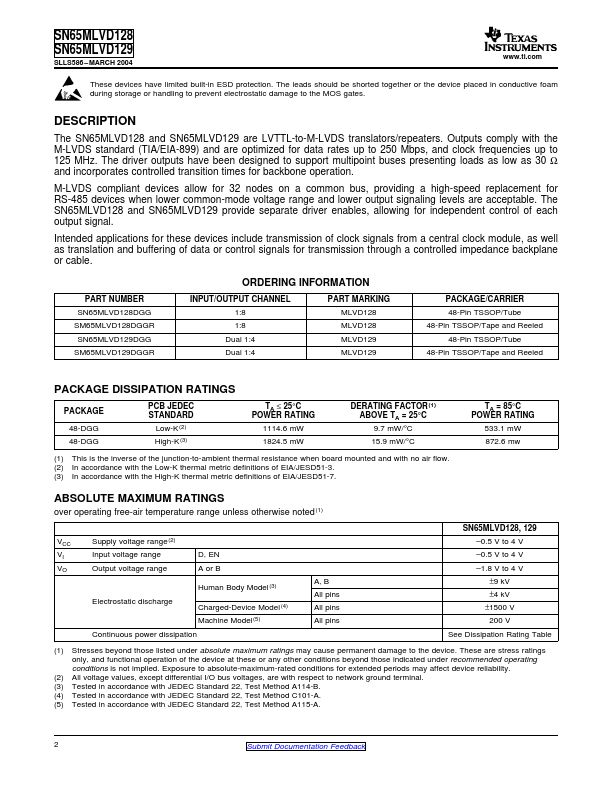
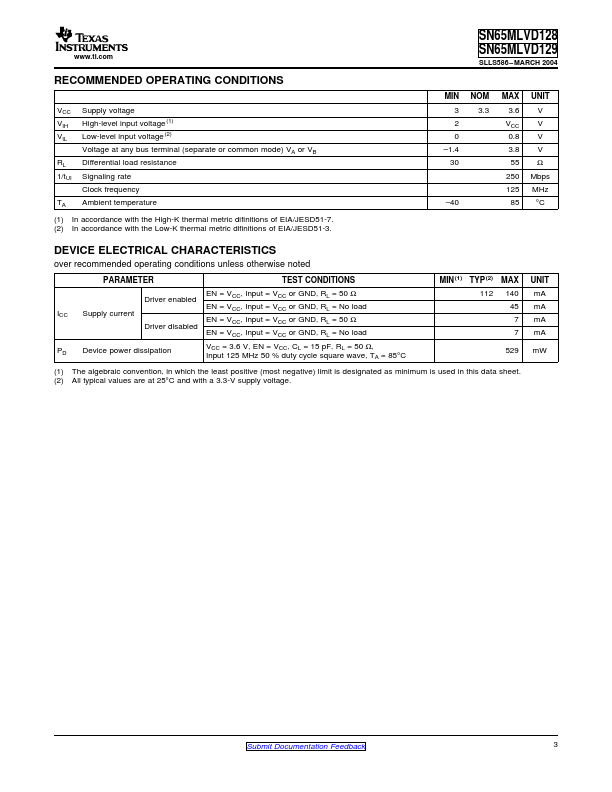
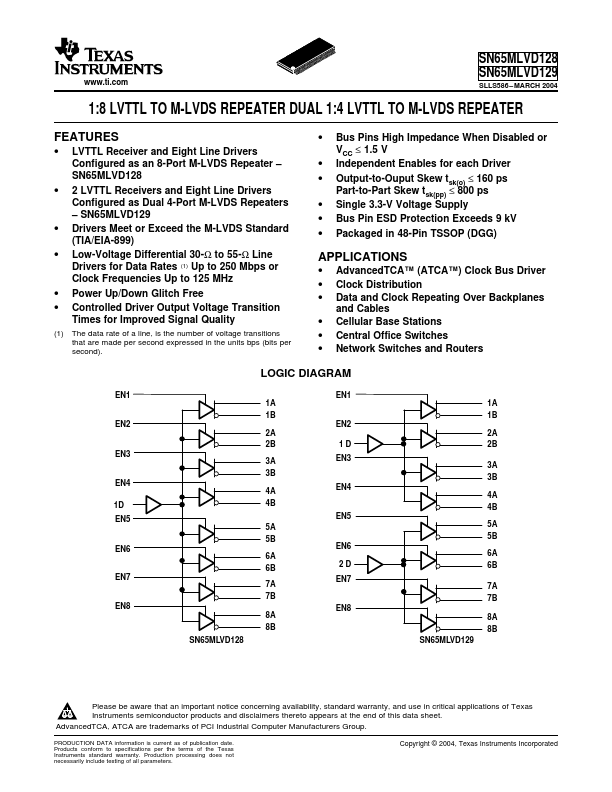
The SN65MLVD128 and SN65MLVD129 are LVTTL-to-M-LVDS translators/repeaters.
Outputs comply with the M-LVDS standard (TIA/EIA-899) and are optimized for data rates up to 250 Mbps, and clock frequencies up to 125 MHz.
| Part number | SN65MLVD129 |
|---|---|
| Manufacturer | Texas Instruments |
| File Size | 637.09 KB |
| Description | 1:8 LVTTL TO M-LVDS REPEATER DUAL 1:4 LVTTL TO M-LVDS REPEATER |
| Datasheet |
SN65MLVD129 Datasheet
|
|
|
|
| Part Number | Description |
|---|---|
| SN65MLVD128 | 1:8 LVTTL TO M-LVDS REPEATER DUAL 1:4 LVTTL TO M-LVDS REPEATER |
| SN65MLVD040 | 4-Channel Half-Duplex M-LVDS Line Transceivers |
| SN65MLVD047 | MULTIPOINT-LVDS QUAD DIFFERENTIAL LINE DRIVER |
| SN65MLVD047A | Multipoint-LVDS Quad Differential Line Driver |
| SN65MLVD048 | Quad Channel M-LVDS Receivers |
| SN65MLVD080 | 8-CHANNEL HALF-DUPLEX M-LVDS LINE TRANSCEIVERS |
| SN65MLVD082 | 8-CHANNEL HALF-DUPLEX M-LVDS LINE TRANSCEIVERS |
| SN65MLVD2 | Single M-LVDS Receivers |
| SN65MLVD200 | MULTIPOINT-LVDS LINE DRIVERS AND RECEIVERS |
| SN65MLVD200A | Multipoint-LVDS Line Driver and Receiver |
The following content is an automatically extracted verbatim text from the original manufacturer datasheet and is provided for reference purposes only.