Datasheet4U Logo Datasheet4U.com

NB3V1104C - 3.3V/2.5V/1.8V LVCMOS Low Skew Fanout Buffer

This page provides the datasheet information for the NB3V1104C, a member of the NB3V1102C 3.3V/2.5V/1.8V LVCMOS Low Skew Fanout Buffer family.

Description

The NB3V110xC are a modular, high performance, low

general purpose LVCMOS clock buffer family.

The family of devices is designed with a modular approach.

out variations, 1:2, 1:3, 1:4, 1:6 and 1:8, are available.

Features

  • Operating Temperature Range:.
  • 40°C to 105°C.
  • High.
  • Performance 1:2, 1:3, 1:4, 1:6, 1:8 LVCMOS Clock Buffer.
  • Available in 8.
  • , 14.
  • , 16.
  • Pin TSSOP and WDFN8 Packages.
  • Very Low Output.
  • to.
  • Output Skew < 50 ps.
  • Very Low Additive Jitter < 200 fs.
  • Supply Voltage: 3.3 V, 2.5 V or 1.8 V.
  • fmax = 250 MHz for 3.3 V; fmax = 180 MHz for 2.5 V; fmax = 133 MHz for 1.8 V.
  • These Devices are.

📥 Download Datasheet

Datasheet preview – NB3V1104C

Datasheet Details

Part number NB3V1104C
Manufacturer Onsemi
File Size 326.86 KB
Description 3.3V/2.5V/1.8V LVCMOS Low Skew Fanout Buffer
Datasheet download datasheet NB3V1104C Datasheet
Additional preview pages of the NB3V1104C datasheet.
Other Datasheets by ON Semiconductor

Full PDF Text Transcription

Click to expand full text
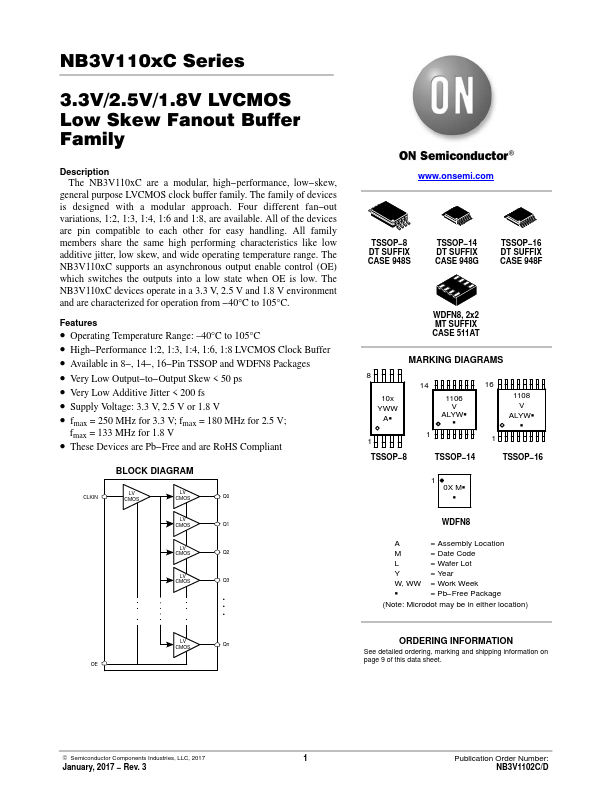
NB3V110xC Series 3.3V/2.5V/1.8V LVCMOS Low Skew Fanout Buffer Family Description The NB3V110xC are a modular, high−performance, low−skew, general purpose LVCMOS clock buffer family. The family of devices is designed with a modular approach. Four different fan−out variations, 1:2, 1:3, 1:4, 1:6 and 1:8, are available. All of the devices are pin compatible to each other for easy handling. All family members share the same high performing characteristics like low additive jitter, low skew, and wide operating temperature range. The NB3V110xC supports an asynchronous output enable control (OE) which switches the outputs into a low state when OE is low. The NB3V110xC devices operate in a 3.3 V, 2.5 V and 1.8 V environment and are characterized for operation from −40°C to 105°C.
Published: |