Datasheet4U Logo Datasheet4U.com

SLA7062M - (SLA7060M - SLA7067M) 2-Phase Unipolar Stepper Motor Driver

General Description

Combining low-power CMOS logic with high-current, high-voltage power FET outputs, the Series SLA706xM translator/drivers provide complete control and drive for a two-phase unipolar stepper motor with internal fixed off time and pulse-width modulation (PWM) control of the output current in a power mu

Key Features

  • ut Rating.
  • Internal Sequencer for Microstepping Operation.
  • PWM Constant-Current Motor Drive.
  • Cost-Effective, Multi-Chip Solution.
  • 100 V, Avalanche-Rated NMOS Outputs.
  • Low rDS(on) NMOS Outputs (150 milli-ohms typical).
  • Advanced, Improved Body Diodes.
  • nputs Compatible with 3.3 V or 5 V Control Signals.
  • Sleep Mode.
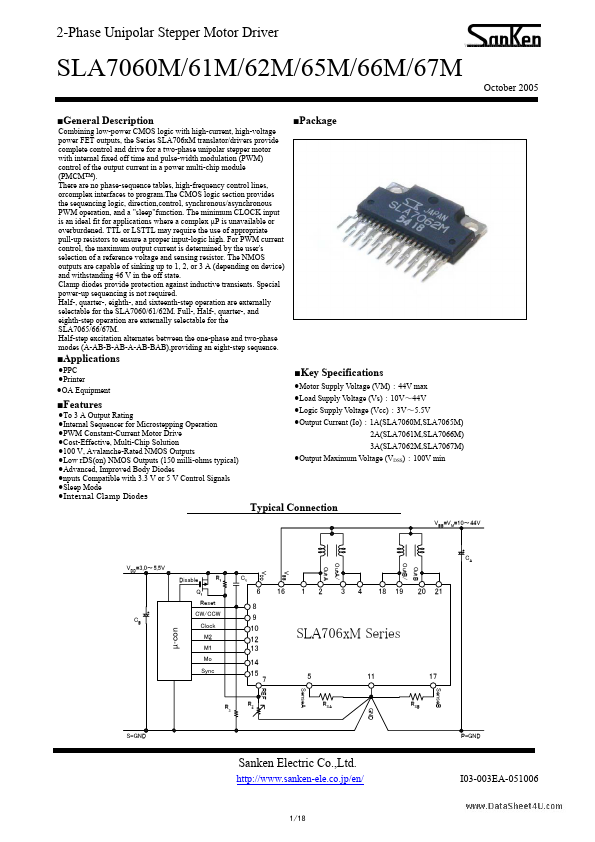
  • Internal Clamp Diodes Typical Connection VBB=VM=10~ 44V CA OutB/ OutA/ VDD=3.0~ 5.5V Disable Q1 Reset CB CW/CCW R1 C1 OutB OutA VDD VBB 6 8 9 10 12.

📥 Download Datasheet

Datasheet Details

Part number SLA7062M
Manufacturer Sanken
File Size 733.89 KB
Description (SLA7060M - SLA7067M) 2-Phase Unipolar Stepper Motor Driver
Datasheet download datasheet SLA7062M Datasheet

Full PDF Text Transcription (Reference)

The following content is an automatically extracted verbatim text from the original manufacturer datasheet and is provided for reference purposes only.

View original datasheet text
2-Phase Unipolar Stepper Motor Driver www.DataSheet4U.com SLA7060M/61M/62M/65M/66M/67M October 2005 ■General Description Combining low-power CMOS logic with high-current, high-voltage power FET outputs, the Series SLA706xM translator/drivers provide complete control and drive for a two-phase unipolar stepper motor with internal fixed off time and pulse-width modulation (PWM) control of the output current in a power multi-chip module (PMCM™). There are no phase-sequence tables, high-frequency control lines, orcomplex interfaces to program.The CMOS logic section provides the sequencing logic, direction,control, synchronous/asynchronous PWM operation, and a "sleep"function. The minimum CLOCK input is an ideal fit for applications where a complex µP is unavailable or overburdened.