
Datasheet Details
| Part number | SA1921 |
|---|---|
| Manufacturer | Philips Semiconductors (now NXP Semiconductors) |
| File Size | 507.88 KB |
| Description | Satellite and cellular dual-band RF front-end |
| Datasheet |
 SA1921 Datasheet SA1921 Datasheet
|
|
|

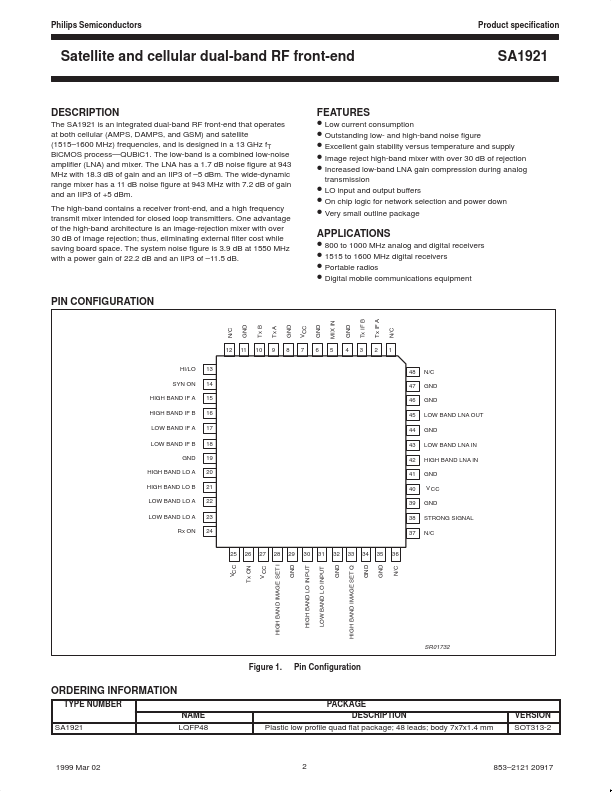
QUBiC1.
The low-band is a combined low-noise amplifier (LNA) and mixer.
| Part number | SA1921 |
|---|---|
| Manufacturer | Philips Semiconductors (now NXP Semiconductors) |
| File Size | 507.88 KB |
| Description | Satellite and cellular dual-band RF front-end |
| Datasheet |
SA1921 Datasheet
|
|
|
|
| Part Number | Description | Manufacturer |
|---|---|---|
| SA190 | AXIAL LEAD TRANSIENT VOLTAGE SUPPRESSORS | MIC |
| SA190 | GLASS PASSIVATED JUNCTION TRANSIENT VOLTAGE SUPPRESSOR | SEMITECH |
| SA190 | TRANSIENT VOLTAGE SUPPRESSOR | DC COMPONENTS |
| SA190 | 500W TRANSIENT VOLTAGE SUPPRESSOR | Won-Top Electronics |
| SA190 | GLASS PASSIVATED JUNCTION TRANSIENT VOLTAGE SUPPRESSOR | Pan Jit International |
| Part Number | Description |
|---|---|
| SA1920 | Dual-band RF front-end |
| SA1458 | General purpose operational amplifier |
| SA1458D | General purpose operational amplifier |
| SA1458N | General purpose operational amplifier |
| SA1620 | Low voltage GSM front-end transceiver |
The following content is an automatically extracted verbatim text from the original manufacturer datasheet and is provided for reference purposes only.