Datasheet4U Logo Datasheet4U.com

BGU8823A - Dual channel low-noise high linearity amplifier

Download the BGU8823A datasheet PDF. This datasheet also covers the BGU8823 variant, as both devices belong to the same dual channel low-noise high linearity amplifier family and are provided as variant models within a single manufacturer datasheet.

Description

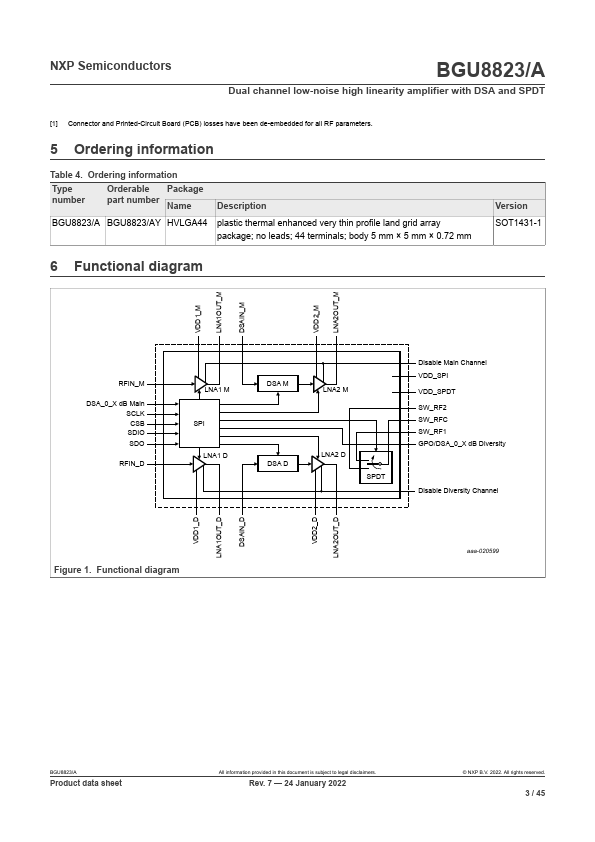
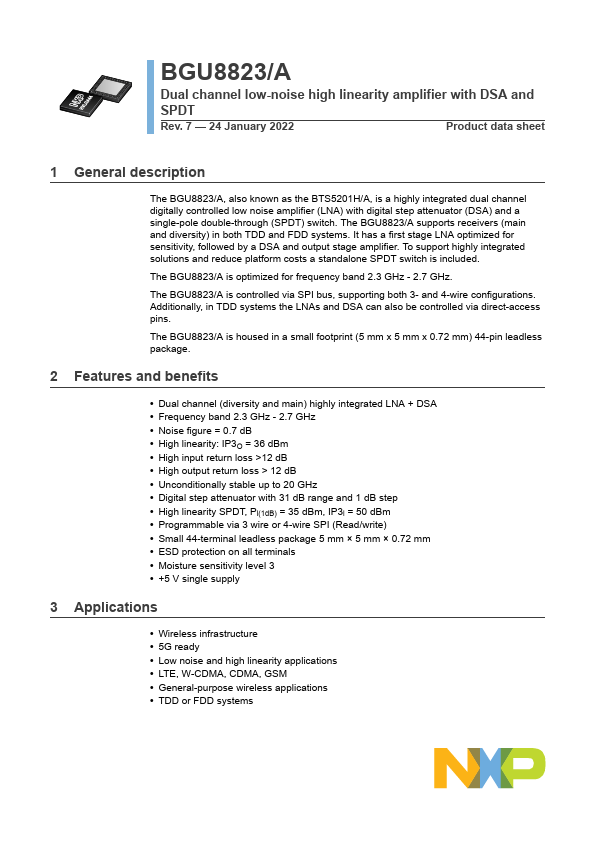
The BGU8823/A, also known as the BTS5201H/A, is a highly integrated dual channel digitally controlled low noise amplifier (LNA) with digital step attenuator (DSA) and a single-pole double-through (SPDT) switch.

The BGU8823/A supports receivers (main and diversity) in both TDD and FDD systems.

Features

  • Dual channel (diversity and main) highly integrated LNA + DSA.
  • Frequency band 2.3 GHz - 2.7 GHz.
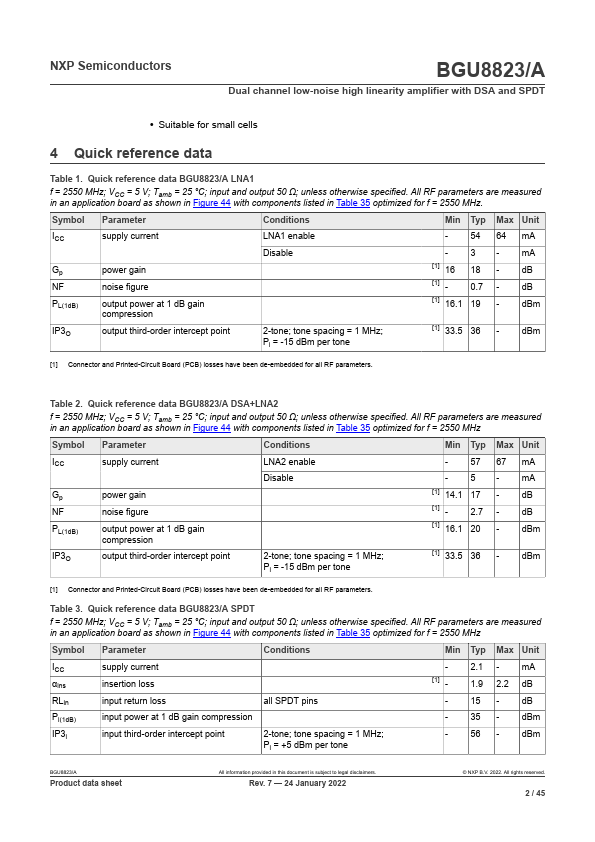
  • Noise figure = 0.7 dB.
  • High linearity: IP3O = 36 dBm.
  • High input return loss >12 dB.
  • High output return loss > 12 dB.
  • Unconditionally stable up to 20 GHz.
  • Digital step attenuator with 31 dB range and 1 dB step.
  • High linearity SPDT, Pi(1dB) = 35 dBm, IP3i = 50 dBm.
  • Programmable via 3 wire or 4-wire SPI (Read/wri.

📥 Download Datasheet

Note: The manufacturer provides a single datasheet file (BGU8823-NXP.pdf) that lists specifications for multiple related part numbers.

Full PDF Text Transcription

Click to expand full text
BGU8823/A Dual channel low-noise high linearity amplifier with DSA and SPDT Rev. 7 — 24 January 2022 Product data sheet 1 General description The BGU8823/A, also known as the BTS5201H/A, is a highly integrated dual channel digitally controlled low noise amplifier (LNA) with digital step attenuator (DSA) and a single-pole double-through (SPDT) switch. The BGU8823/A supports receivers (main and diversity) in both TDD and FDD systems. It has a first stage LNA optimized for sensitivity, followed by a DSA and output stage amplifier. To support highly integrated solutions and reduce platform costs a standalone SPDT switch is included. The BGU8823/A is optimized for frequency band 2.3 GHz - 2.7 GHz. The BGU8823/A is controlled via SPI bus, supporting both 3- and 4-wire configurations.

Published: |