
Datasheet Details
| Part number | CHP3010-QFG |
|---|---|
| Manufacturer | United Monolithic Semiconductors |
| File Size | 1.19 MB |
| Description | L-Band 6-Bit Digital Phase Shifter |
| Datasheet |
 CHP3010-QFG Datasheet CHP3010-QFG Datasheet
|
|
|

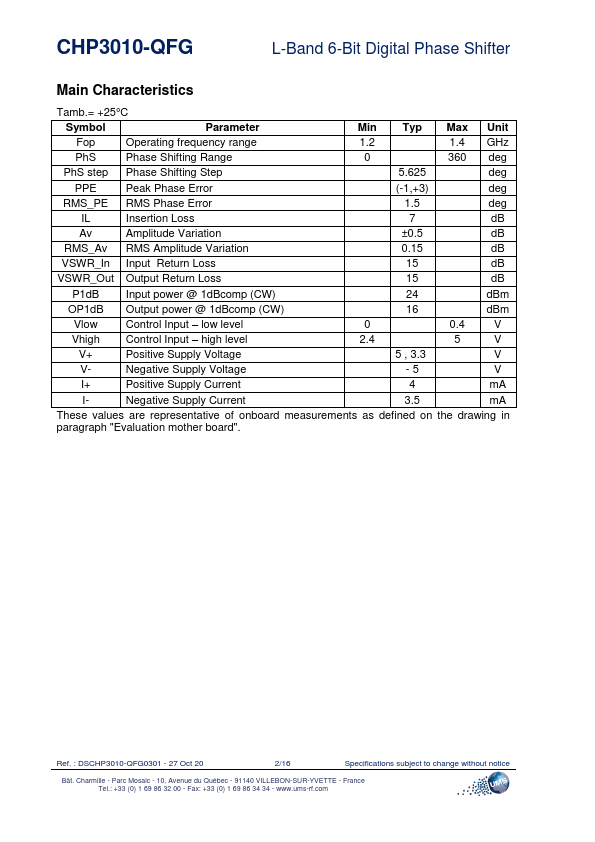
CHP3010-QFG is an L-Band (1.2,1.4GHz) monolithic 6 bit digital phase-shifter with a 0-360° range and a high phase accuracy.
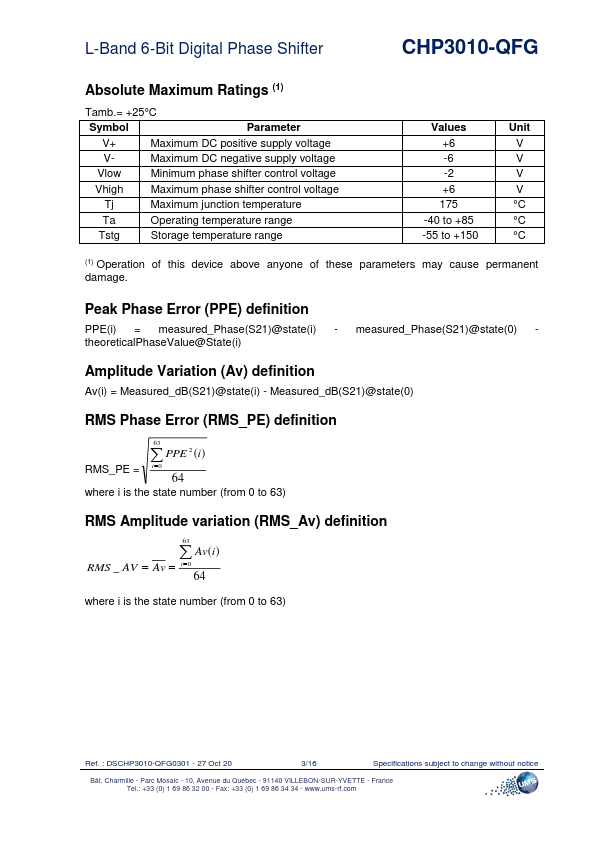
The typical RMS phase error is 1.5°.
The circuit provides 7dB insertion loss associated with input and output return losses better than 15dB under all logic states.
| Part number | CHP3010-QFG |
|---|---|
| Manufacturer | United Monolithic Semiconductors |
| File Size | 1.19 MB |
| Description | L-Band 6-Bit Digital Phase Shifter |
| Datasheet |
CHP3010-QFG Datasheet
|
|
|
|
| Part Number | Description | Manufacturer |
|---|---|---|
| CHP | High Stability Resistor Chips | Vishay Intertechnology |
| CHP0502 | High Stability Resistor | Vishay Intertechnology |
| CHP0505 | High Stability Resistor | Vishay Intertechnology |
| CHP0603 | Ultra-High Power Chip Resistors | BOURNS |
| CHP0603 | High Stability Resistor | Vishay Intertechnology |
| Part Number | Description |
|---|---|
| CHP3010A98F | GaAs Monolithic Microwave |
| CHP3015-99F | X-Band 6-Bit Digital Phase Shifter |
| CHP3015-QDG | 8.5-10.5GHz Phase Shifter |
| CHP1102-98F | S-Band 6-bit Phase Shifter |
| CHP1102-QGG | S-Band 6-bit Phase Shifter |
The following content is an automatically extracted verbatim text from the original manufacturer datasheet and is provided for reference purposes only.