Datasheet4U Logo Datasheet4U.com

IS49NLC18160 - 288Mb Common I/O RLDRAM 2 Memory

Download the IS49NLC18160 datasheet PDF. This datasheet also covers the IS49NLC93200 variant, as both devices belong to the same 288mb common i/o rldram 2 memory family and are provided as variant models within a single manufacturer datasheet.

Description

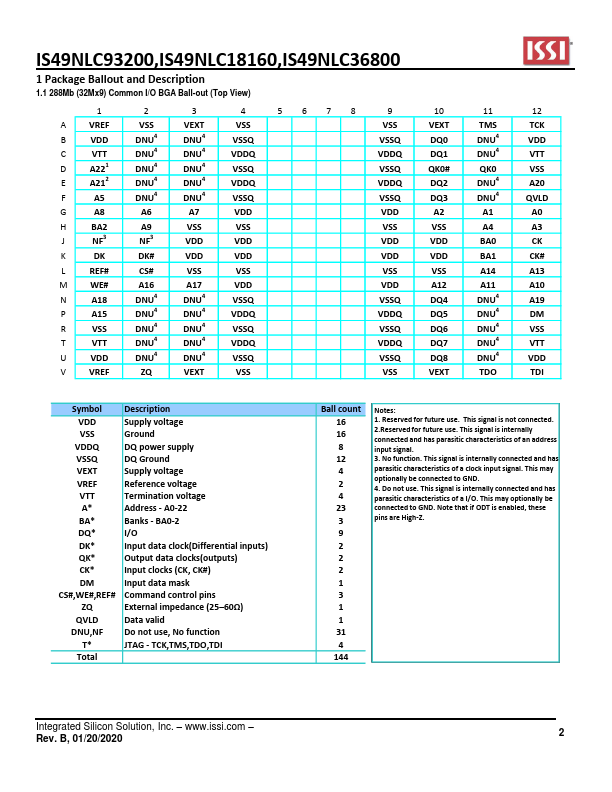
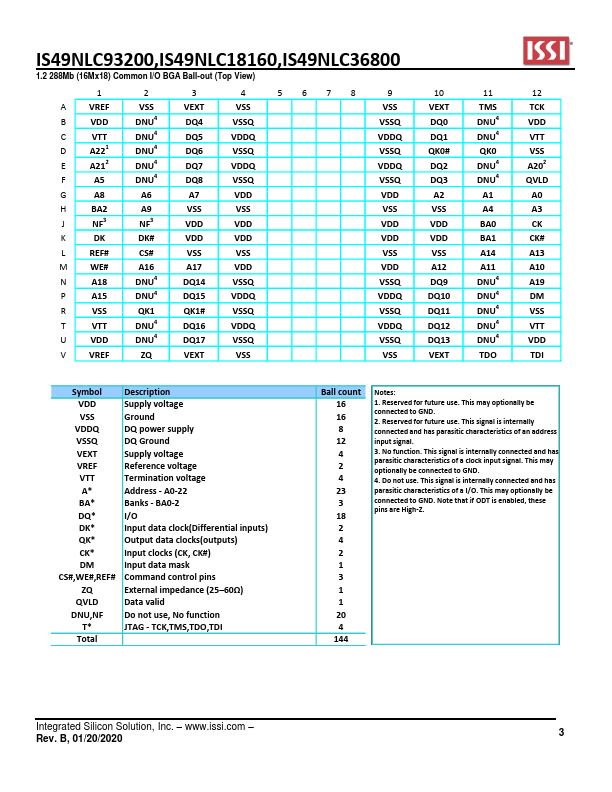
1.1 288Mb (32Mx9) Common I/O BGA Ball-out (Top View) 1 A VREF B VDD C VTT D A221 E A212 F A5 G A8 H BA2 J NF3 K DK L REF# M WE# N A18 P A15 R VSS T VTT U VDD V VREF 2 VSS DNU4 DNU4 DNU4 DNU4 DNU4 A6 A9 NF3 DK# CS# A16 DNU4 DNU4 DNU4 DNU4 DNU4 ZQ 3 VEXT DNU4 DNU4 DNU4

Features

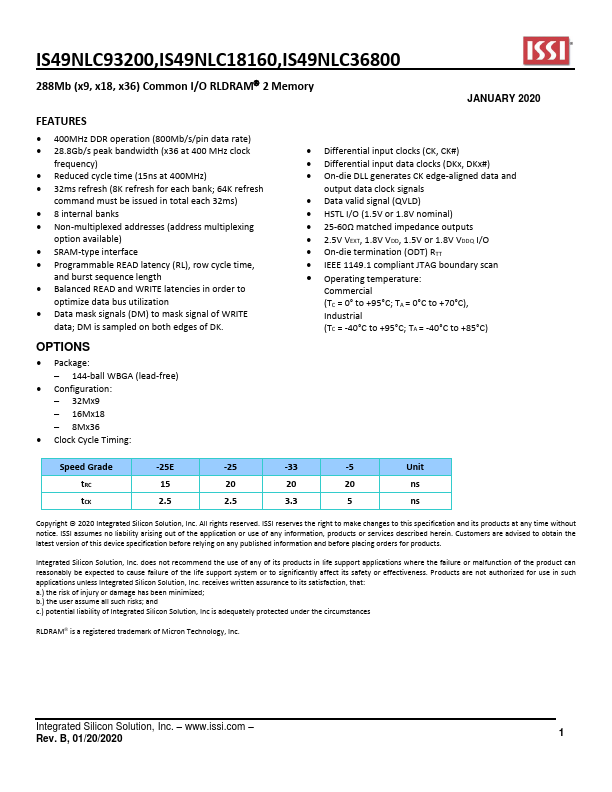
  • 400MHz DDR operation (800Mb/s/pin data rate).
  • 28.8Gb/s peak bandwidth (x36 at 400 MHz clock frequency).
  • Reduced cycle time (15ns at 400MHz).
  • 32ms refresh (8K refresh for each bank; 64K refresh command must be issued in total each 32ms).
  • 8 internal banks.
  • Non-multiplexed addresses (address multiplexing option available).
  • SRAM-type interface.
  • Programmable READ latency (RL), row cycle time, and burst sequence length.
  • Balanced READ and WRITE latencies in.

📥 Download Datasheet

Note: The manufacturer provides a single datasheet file (IS49NLC93200-IntegratedSiliconSolution.pdf) that lists specifications for multiple related part numbers.

Full PDF Text Transcription (Reference)

The following content is an automatically extracted verbatim text from the original manufacturer datasheet and is provided for reference purposes only.

View original datasheet text
IS49NLC93200,IS49NLC18160,IS49NLC36800 288Mb (x9, x18, x36) Common I/O RLDRAM 2 Memory JANUARY 2020 FEATURES  400MHz DDR operation (800Mb/s/pin data rate)  28.8Gb/s peak bandwidth (x36 at 400 MHz clock frequency)  Reduced cycle time (15ns at 400MHz)  32ms refresh (8K refresh for each bank; 64K refresh command must be issued in total each 32ms)  8 internal banks  Non-multiplexed addresses (address multiplexing option available)  SRAM-type interface  Programmable READ latency (RL), row cycle time, and burst sequence length  Balanced READ and WRITE latencies in order to optimize data bus utilization  Data mask signals (DM) to mask signal of WRITE data; DM is sampled on both edges of DK.

Published: |