
TPIC6595
TPIC6595 is Power Logic 8-bit Shift Register manufactured by Texas Instruments.
SLIS010C
- APRIL 1992
- REVISED MARCH 2025
TPIC6595 Power Logic 8-bit Shift Register
1 Features
- Low r DS(on): 1.3Ω typical
- Avalanche energy: 75m J
- Eight power DMOS transistor outputs of 250m A continuous current
- 1.5A pulsed current per output
- Output clamp voltage at 45V
- Devices can cascade
- Low power consumption
2 Applications
- Instrumentation clusters
- Tell-tale lamps
- LED illumination and controls
- Automotive relay or solenoids drivers
3 Description
The TPIC6595 is a monolithic, high-voltage, highcurrent power 8-bit shift register designed for use in systems that require relatively high load power. The device contains a built-in voltage clamp on the outputs for inductive transient protection. Power driver applications include relays, solenoids, and other medium-current or high-voltage loads.
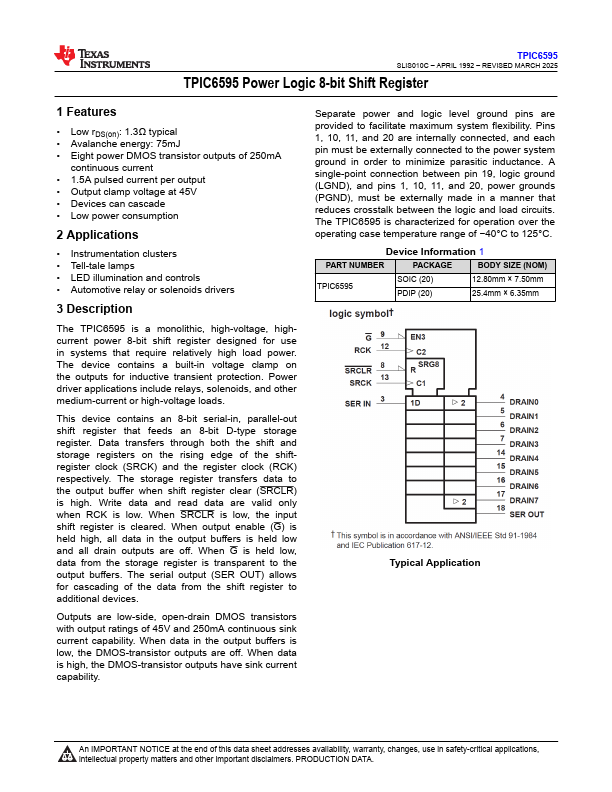
This device contains an 8-bit serial-in, parallel-out shift register that feeds an 8-bit D-type storage register. Data transfers through both the shift and storage registers on the rising edge of the shiftregister clock (SRCK) and the register clock (RCK) respectively. The storage register transfers data to the output buffer when shift register clear (SRCLR) is high. Write data and read data are valid only when RCK is low. When SRCLR is low, the input shift register is cleared. When output enable (G) is held high, all data in the output buffers is held low and all drain outputs are off. When G is held low, data from the storage register is transparent to the output buffers. The serial output (SER OUT) allows for cascading of the data from the shift register to additional devices.
Outputs are low-side, open-drain DMOS transistors with output ratings of 45V and 250m A continuous sink current capability. When data in the output buffers is low, the DMOS-transistor outputs are off. When data is high, the DMOS-transistor outputs have sink current capability.
Separate power and logic level ground pins are provided to facilitate maximum system flexibility....