
Datasheet4U Logo Datasheet4U.com

CD54HC238 - High-Speed CMOS Logic 3 to 8-Line Decoder/Demultiplexer Inverting/Noninverting

This page provides the datasheet information for the CD54HC238, a member of the CD54HC138 High-Speed CMOS Logic 3 to 8-Line Decoder/Demultiplexer Inverting/Noninverting family.

Description

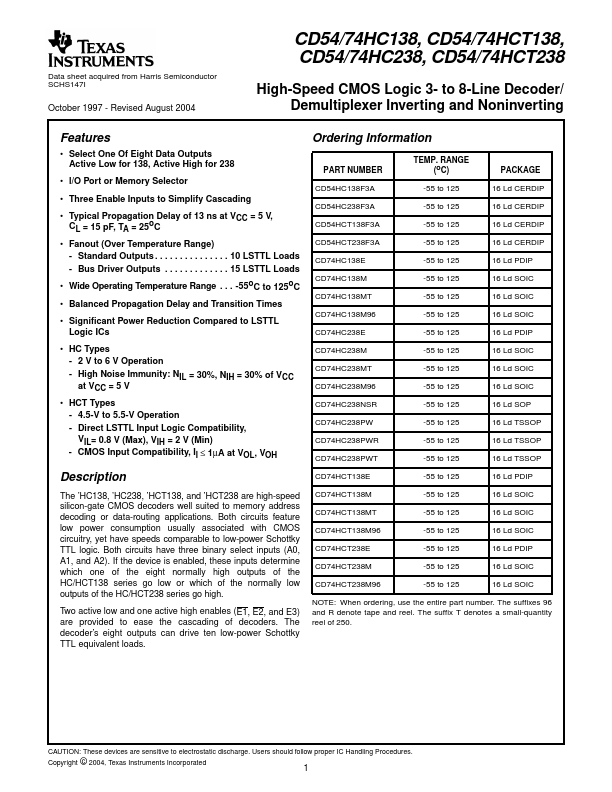
The ’HC138, ’HC238, ’HCT138, and ’HCT238 are high-speed silicon-gate CMOS decoders well suited to memory address decoding or data-routing applications.

Features

  • Select One Of Eight Data Outputs Active Low for 138, Active High for 238.
  • l/O Port or Memory Selector.
  • Three Enable Inputs to Simplify Cascading.
  • Typical CL = 15 Propagation Delay pF, TA = 25oC of 13 ns at VCC = 5 V,.
  • Fanout (Over Temperature Range) - Standard Outputs.
  • 10 LSTTL Loads - Bus Driver Outputs.
  • . . . 15 LSTTL Loads.
  • Wide Operating Temperature Range . . . -55oC to 125oC.

📥 Download Datasheet

Datasheet preview – CD54HC238

Datasheet Details

Part number CD54HC238
Manufacturer Texas Instruments
File Size 1.28 MB
Description High-Speed CMOS Logic 3 to 8-Line Decoder/Demultiplexer Inverting/Noninverting
Datasheet download datasheet CD54HC238 Datasheet
Additional preview pages of the CD54HC238 datasheet.
Other Datasheets by Texas Instruments

Full PDF Text Transcription

Click to expand full text
Data sheet acquired from Harris Semiconductor SCHS147I October 1997 - Revised August 2004 CD54/74HC138, CD54/74HCT138, CD54/74HC238, CD54/74HCT238 High-Speed CMOS Logic 3- to 8-Line Decoder/ Demultiplexer Inverting and Noninverting [ /Title (CD74 HC138 , CD74 HCT13 8, CD74 HC238 , CD74 HCT23 8) /Subject (High Speed Features • Select One Of Eight Data Outputs Active Low for 138, Active High for 238 • l/O Port or Memory Selector • Three Enable Inputs to Simplify Cascading • Typical CL = 15 Propagation Delay pF, TA = 25oC of 13 ns at VCC = 5 V, • Fanout (Over Temperature Range) - Standard Outputs . . . . . . . . . . . . . . . 10 LSTTL Loads - Bus Driver Outputs . . . . . . . . . . . . . 15 LSTTL Loads • Wide Operating Temperature Range . . .
Published: |