
Datasheet Details
| Part number | SGA-3486Z |
|---|---|
| Manufacturer | Sirenza Microdevices |
| File Size | 88.67 KB |
| Description | Cascadable SiGe HBT MMIC Amplifier |
| Datasheet |
 SGA-3486Z Datasheet SGA-3486Z Datasheet
|
|
|

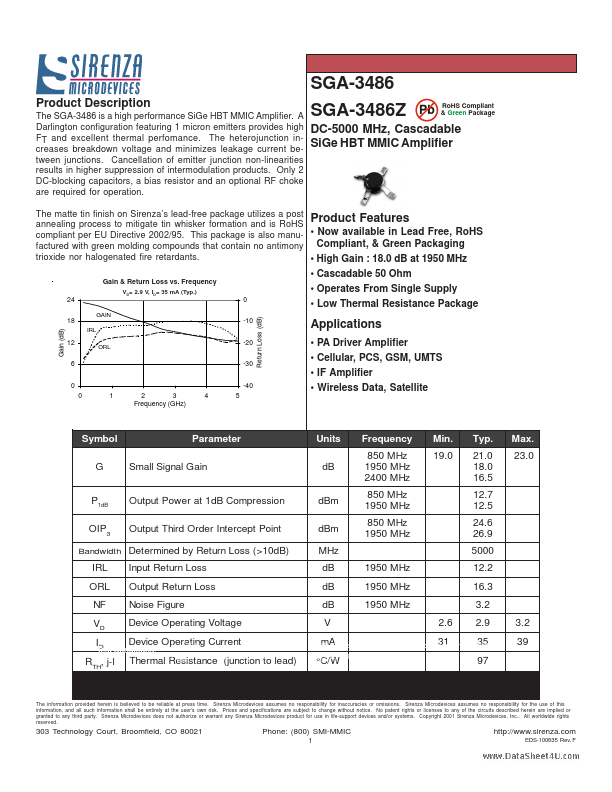
The SGA-3486 is a high performance SiGe HBT MMIC Amplifier.
A Darlington configuration featuring 1 micron emitters provides high FT and excellent thermal perfomance.
The heterojunction increases breakdown voltage and minimizes leakage current between junctions.
| Part number | SGA-3486Z |
|---|---|
| Manufacturer | Sirenza Microdevices |
| File Size | 88.67 KB |
| Description | Cascadable SiGe HBT MMIC Amplifier |
| Datasheet |
SGA-3486Z Datasheet
|
|
|
|
| Part Number | Description | Manufacturer |
|---|---|---|
| SGA-3486Z | CASCADABLE SiGe HBT MMIC AMPLIFIER | RFMD |
| SGA-3486 | CASCADABLE SiGe HBT MMIC AMPLIFIER | RFMD |
| SGA-1263 | DC to 4000MHz SILICON GERMANIUM HBT CASCADABLE GAIN BLOCK | RFMD |
| SGA-1263Z | DC to 4000MHz SILICON GERMANIUM HBT CASCADABLE GAIN BLOCK | RFMD |
| SGA-2286 | CASCADABLE SiGe HBT MMIC AMPLIFIER | RFMD |
| Part Number | Description |
|---|---|
| SGA-3486 | Cascadable SiGe HBT MMIC Amplifier |
| SGA-3463 | Cascadable SiGe HBT MMIC Amplifier |
| SGA-3463Z | Cascadable SiGe HBT MMIC Amplifier |
| SGA-3263 | Cascadable SiGe HBT MMIC Amplifier |
| SGA-3263Z | Cascadable SiGe HBT MMIC Amplifier |
The following content is an automatically extracted verbatim text from the original manufacturer datasheet and is provided for reference purposes only.