Datasheet4U Logo Datasheet4U.com

BM1P062FJ - DC/DC converter

Download the BM1P062FJ datasheet PDF. This datasheet also covers the BM1P061FJ variant, as both devices belong to the same dc/dc converter family and are provided as variant models within a single manufacturer datasheet.

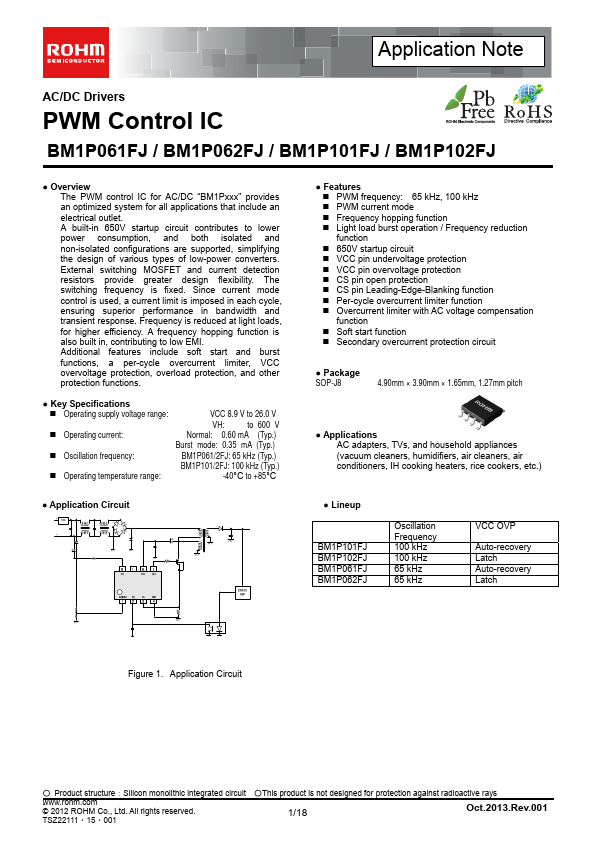
Features

  • PWM frequency: 65 kHz, 100 kHz.
  • PWM current mode.
  • Frequency hopping function.
  • Light load burst operation / Frequency reduction function.
  • 650V startup circuit.
  • VCC pin undervoltage protection.
  • VCC pin overvoltage protection.
  • CS pin open protection.
  • CS pin Leading-Edge-Blanking function.
  • Per-cycle overcurrent limiter function.
  • Overcurrent limiter with AC voltage compensation function.
  • Soft start function.
  • Secondary overcurrent protectio.

📥 Download Datasheet

Note: The manufacturer provides a single datasheet file (BM1P061FJ-ROHM.pdf) that lists specifications for multiple related part numbers.

Datasheet Details

Part number BM1P062FJ
Manufacturer ROHM
File Size 1.16 MB
Description DC/DC converter
Datasheet download datasheet BM1P062FJ Datasheet

Full PDF Text Transcription (Reference)

The following content is an automatically extracted verbatim text from the original manufacturer datasheet and is provided for reference purposes only.

View original datasheet text
ApplicatioDnatNasohteeet AC/DC Drivers PWM Control IC BM1P061FJ / BM1P062FJ / BM1P101FJ / BM1P102FJ ● Overview The PWM control IC for AC/DC “BM1Pxxx” provides an optimized system for all applications that include an electrical outlet. A built-in 650V startup circuit contributes to lower power consumption, and both isolated and non-isolated configurations are supported, simplifying the design of various types of low-power converters. External switching MOSFET and current detection resistors provide greater design flexibility. The switching frequency is fixed. Since current mode control is used, a current limit is imposed in each cycle, ensuring superior performance in bandwidth and transient response. Frequency is reduced at light loads, for higher efficiency.
Published: |