
Datasheet4U Logo Datasheet4U.com

DS90CF388 - Dual Pixel LVDS Display Interface

Datasheet Summary

Description

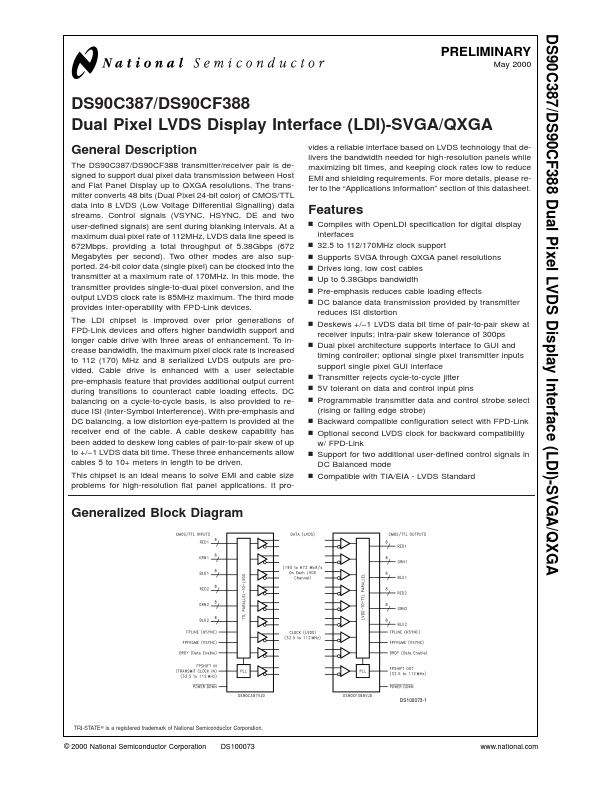
The DS90C387/DS90CF388 transmitter/receiver pair is designed to support dual pixel data transmission between Host and Flat Panel Display up to QXGA resolutions.

The transmitter converts 48 bits (Dual Pixel 24-bit color) of CMOS/TTL data into 8 LVDS (Low Voltage Differential Signalling) data streams.

Features

  • n Complies with OpenLDI specification for digital display interfaces n 32.5 to 112/170MHz clock support n Supports SVGA through QXGA panel resolutions n Drives long, low cost cables n Up to 5.38Gbps bandwidth n Pre-emphasis reduces cable loading effects n DC balance data transmission provided by transmitter reduces ISI distortion n Deskews +/.
  • 1 LVDS data bit time of pair-to-pair skew at receiver inputs; intra-pair skew tolerance of 300ps n Dual pixel architecture supports interface to GU.

📥 Download Datasheet

Datasheet preview – DS90CF388

Datasheet Details

Part number DS90CF388
Manufacturer National Semiconductor
File Size 450.54 KB
Description Dual Pixel LVDS Display Interface
Datasheet download datasheet DS90CF388 Datasheet
Additional preview pages of the DS90CF388 datasheet.
Other Datasheets by National Semiconductor

Full PDF Text Transcription

Click to expand full text
DS90C387/DS90CF388 Dual Pixel LVDS Display Interface (LDI)-SVGA/QXGA PRELIMINARY May 2000 DS90C387/DS90CF388 Dual Pixel LVDS Display Interface (LDI)-SVGA/QXGA General Description The DS90C387/DS90CF388 transmitter/receiver pair is designed to support dual pixel data transmission between Host and Flat Panel Display up to QXGA resolutions. The transmitter converts 48 bits (Dual Pixel 24-bit color) of CMOS/TTL data into 8 LVDS (Low Voltage Differential Signalling) data streams. Control signals (VSYNC, HSYNC, DE and two user-defined signals) are sent during blanking intervals. At a maximum dual pixel rate of 112MHz, LVDS data line speed is 672Mbps, providing a total throughput of 5.38Gbps (672 Megabytes per second). Two other modes are also supported.
Published: |