Datasheet4U Logo Datasheet4U.com

HCTS245T - Radiation Hardened Octal Bus Transceiver/ Three-State/ Non-Inverting

General Description

only.

Intersil Corporation reserves the right to make changes in circuit design and/or specifications at any time without notice.

Accordingly, the reader is cautioned to verify that data sheets are current before placing orders.

Key Features

  • QML Class T, Per MIL-PRF-38535.
  • Radiation Performance - Gamma Dose (γ) 1 x 10⁵ RAD(Si) - Latch-Up Free Under Any Conditions - SEP Effective LET No Upsets: >100 MEV-cm2/mg - Single Event Upset (SEU) Immunity < 2 x 10⁻⁹ Errors/Bit-Day (Typ).
  • 3 Micron Radiation Hardened CMOS SOS.
  • Fanout (Over Temperature Range) - Bus Driver Outputs - 15 LSTTL Loads.
  • Significant Power Reduction Compared to LSTTL ICs.
  • DC Operating Voltage Range: 4.5V to 5.5V.

📥 Download Datasheet

Datasheet Details

Part number HCTS245T
Manufacturer Intersil (Renesas)
File Size 93.05 KB
Description Radiation Hardened Octal Bus Transceiver/ Three-State/ Non-Inverting
Datasheet download datasheet HCTS245T Datasheet

Full PDF Text Transcription (Reference)

The following content is an automatically extracted verbatim text from the original manufacturer datasheet and is provided for reference purposes only.

View original datasheet text
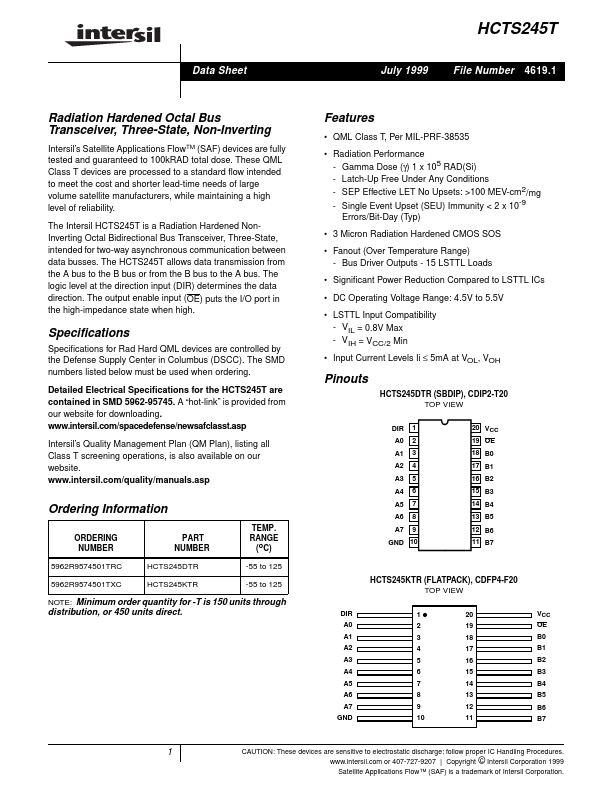
HCTS245T Data Sheet July 1999 File Number 4619.1 Radiation Hardened Octal Bus Transceiver, Three-State, Non-Inverting Intersil’s Satellite Applications FlowTM (SAF) devices are fully tested and guaranteed to 100kRAD total dose. These QML Class T devices are processed to a standard flow intended to meet the cost and shorter lead-time needs of large volume satellite manufacturers, while maintaining a high level of reliability. The Intersil HCTS245T is a Radiation Hardened NonInverting Octal Bidirectional Bus Transceiver, Three-State, intended for two-way asynchronous communication between data busses. The HCTS245T allows data transmission from the A bus to the B bus or from the B bus to the A bus. The logic level at the direction input (DIR) determines the data direction.