
Datasheet4U Logo Datasheet4U.com

S6495 - (S6493 - S6495) Photodiode

Download the S6495 datasheet PDF. This datasheet also covers the S6493 variant, as both devices belong to the same (s6493 - s6495) photodiode family and are provided as variant models within a single manufacturer datasheet.

Key Features

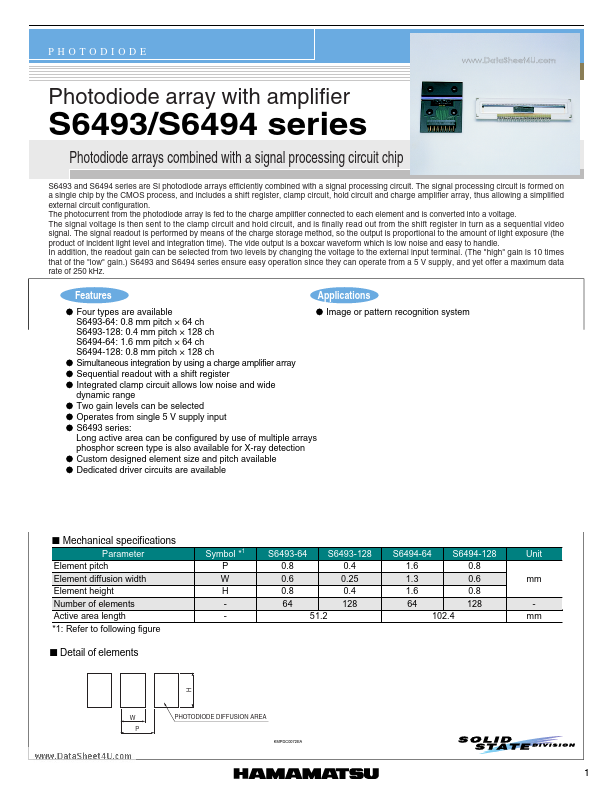
  • S6493-64: 0.8 mm pitch × 64 ch S6493-128: 0.4 mm pitch × 128 ch S6494-64: 1.6 mm pitch × 64 ch S6494-128: 0.8 mm pitch × 128 ch l Simultaneous integration by using a charge amplifier array l Sequential readout with a shift register l Integrated clamp circuit allows low noise and wide dynamic range l Two gain levels can be selected l Operates from single 5 V supply input l S6493 series: Long active area can be configured by use of multiple arrays phosphor screen type is also available for X-ray d.

📥 Download Datasheet

Note: The manufacturer provides a single datasheet file (S6493_Hamamatsu.pdf) that lists specifications for multiple related part numbers.

Datasheet Details

Part number S6495
Manufacturer Hamamatsu
File Size 317.36 KB
Description (S6493 - S6495) Photodiode
Datasheet download datasheet S6495 Datasheet

Full PDF Text Transcription (Reference)

The following content is an automatically extracted verbatim text from the original manufacturer datasheet and is provided for reference purposes only.

View original datasheet text
PHOTODIODE www.DataSheet4U.com Photodiode array with amplifier S6493/S6494 series Photodiode arrays combined with a signal processing circuit chip S6493 and S6494 series are Si photodiode arrays efficiently combined with a signal processing circuit. The signal processing circuit is formed on a single chip by the CMOS process, and includes a shift register, clamp circuit, hold circuit and charge amplifier array, thus allowing a simplified external circuit configuration. The photocurrent from the photodiode array is fed to the charge amplifier connected to each element and is converted into a voltage. The signal voltage is then sent to the clamp circuit and hold circuit, and is finally read out from the shift register in turn as a sequential video signal.