
74F192
74F192 is Up/Down Decade Counter manufactured by Fairchild Semiconductor.
Description
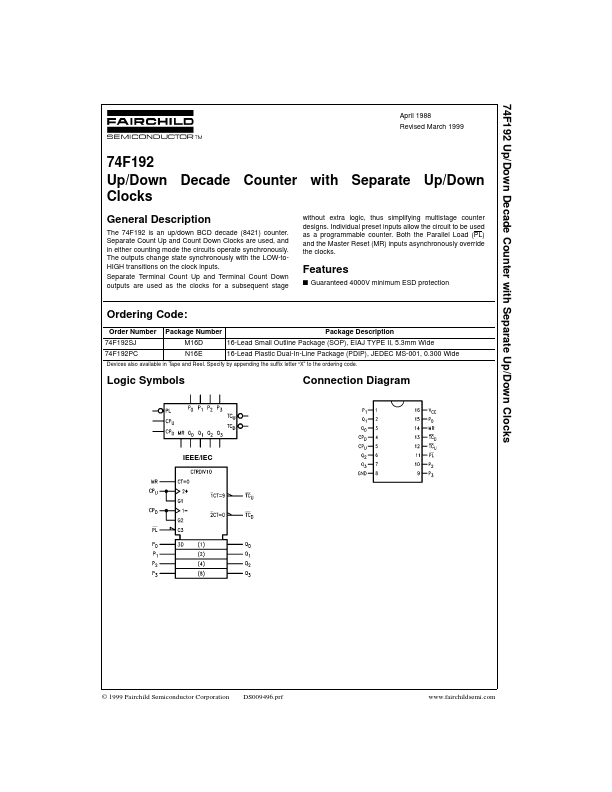
The 74F192 is an up/down BCD decade (8421) counter. Separate Count Up and Count Down Clocks are used, and in either counting mode the circuits operate synchronously. The outputs change state synchronously with the LOW-to HIGH transitions on the clock inputs. Separate Terminal Count Up and Terminal Count Down outputs are used as the clocks for a subsequent stage without extra logic, thus simplifying multistage counter designs. Individual preset inputs allow the circuit to be used as a programmable counter. Both the Parallel Load (PL) and the Master Reset (MR) inputs asynchronously override the clocks.
Features s Guaranteed 4000V minimum ESD protection
Ordering Code:
Order Number 74F192SJ 74F192PC Package Number M16D N16E Package Description
16-Lead Small Outline Package (SOP), EIAJ TYPE II, 5.3mm Wide 16-Lead Plastic Dual-In-Line Package (PDIP), JEDEC MS-001, 0.300 Wide
Devices also available in Tape and Reel. Specify by appending the suffix letter “X” to the ordering code.
Logic Symbols
Connection Diagram
IEEE/IEC
© 1999 Fairchild Semiconductor Corporation
DS009496.prf
.fairchildsemi.
Unit Loading/Fan Out
U.L. Pin Names CPU CPD MR PL P0- P3 Q0- Q3 TCD TCU Description
HIGH/LOW Count Up Clock Input (Active Rising Edge) Count Down Clock Input (Active Rising Edge) Asynchronous Master Reset Input (Active HIGH) Asynchronous Parallel Load Input (Active LOW) Parallel Data Inputs Flip-Flop Outputs Terminal Count Down (Borrow) Output (Active LOW) Terminal Count Up (Carry) Output (Active LOW) 1.0/3.0 1.0/3.0 1.0/1.0 1.0/1.0 1.0/1.0 50/33.3 50/33.3 50/33.3 Input IIH/IIL Output IOH/IOL 20 µA/- 1.8 m A 20 µA/- 1.8 m A 20 µA/- 0.6 m A 20 µA/- 0.6 m A 20 µA/- 0.6 m A
- 1 m A/20 m A
- 1 m A/20 m A
- 1 m A/20 m A
Functional Description
The 74F192 is an asynchronously presettable decade counter. It contains four edge-triggered flip-flops, with internal gating and steering logic to provide master reset, individual preset, count up and count down operations. A LOW-to-HIGH...