Datasheet4U Logo Datasheet4U.com

SN74HC151N - 8-LINE TO 1-LINE DATA SELECTORS/MULTIPLEXERS

This page provides the datasheet information for the SN74HC151N, a member of the SN74HC151 8-LINE TO 1-LINE DATA SELECTORS/MULTIPLEXERS family.

Datasheet Summary

Description

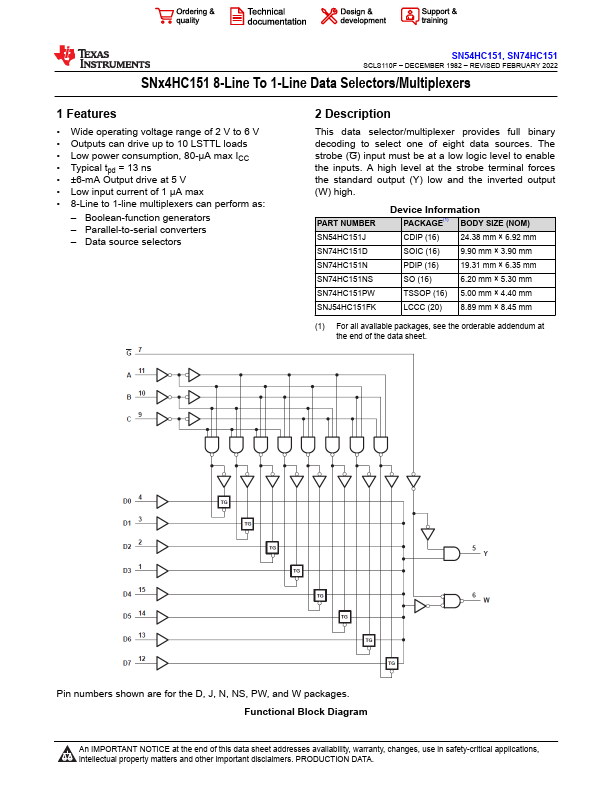
This data selector/multiplexer provides full binary decoding to select one of eight data sources.

The strobe (G) input must be at a low logic level to enable the inputs.

A high level at the strobe terminal forces the standard output (Y) low and the inverted output (W) high.

Features

  • Wide operating voltage range of 2 V to 6 V.
  • Outputs can drive up to 10 LSTTL loads.
  • Low power consumption, 80-μA max ICC.
  • Typical tpd = 13 ns.
  • ±6-mA Output drive at 5 V.
  • Low input current of 1 μA max.
  • 8-Line to 1-line multiplexers can perform as:.
  • Boolean-function generators.
  • Parallel-to-serial converters.
  • Data source selectors 2.

📥 Download Datasheet

Datasheet preview – SN74HC151N

Datasheet Details

Part number SN74HC151N
Manufacturer Texas Instruments
File Size 1.80 MB
Description 8-LINE TO 1-LINE DATA SELECTORS/MULTIPLEXERS
Datasheet download datasheet SN74HC151N Datasheet
Additional preview pages of the SN74HC151N datasheet.
Other Datasheets by Texas Instruments

Full PDF Text Transcription

Click to expand full text
SN54HC151, SN74HC151 SCLS110F – DECEMBER 1982 – REVISED FEBRUARY 2022 SNx4HC151 8-Line To 1-Line Data Selectors/Multiplexers 1 Features • Wide operating voltage range of 2 V to 6 V • Outputs can drive up to 10 LSTTL loads • Low power consumption, 80-μA max ICC • Typical tpd = 13 ns • ±6-mA Output drive at 5 V • Low input current of 1 μA max • 8-Line to 1-line multiplexers can perform as: – Boolean-function generators – Parallel-to-serial converters – Data source selectors 2 Description This data selector/multiplexer provides full binary decoding to select one of eight data sources. The strobe (G) input must be at a low logic level to enable the inputs. A high level at the strobe terminal forces the standard output (Y) low and the inverted output (W) high.
Published: |