Datasheet4U Logo Datasheet4U.com

SMS24C - TVS Diode Array For ESD and Latch-Up Protection

Datasheet Summary

Description

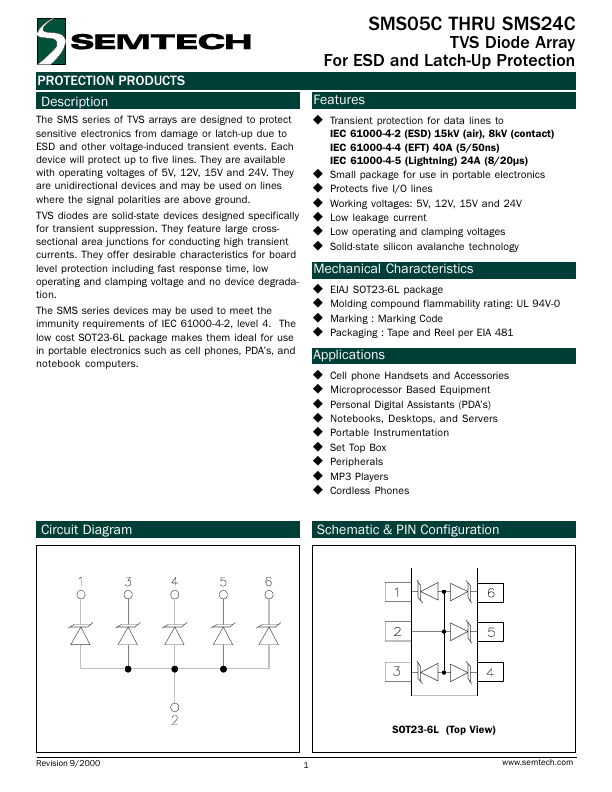
The SMS series of TVS arrays are designed to protect sensitive electronics from damage or latch-up due to ESD and other voltage-induced transient events.

Each device will protect up to five lines.

They are available with operating voltages of 5V, 12V, 15V and 24V.

Features

  • u Transient protection for data lines to IEC 61000-4-2 (ESD) 15kV (air), 8kV (contact) IEC 61000-4-4 (EFT) 40A (5/50ns) IEC 61000-4-5 (Lightning) 24A (8/20µs) Small package for use in portable electronics Protects five I/O lines Working voltages: 5V, 12V, 15V and 24V Low leakage current Low operating and clamping voltages Solid-state silicon avalanche technology u u u u u u u u u u u u u u u u u u u Mechanical Characteristics EIAJ SOT23-6L package Molding compound flammability rating: UL 94V-0.

📥 Download Datasheet

Datasheet preview – SMS24C

Datasheet Details

Part number SMS24C
Manufacturer Semtech Corporation
File Size 164.72 KB
Description TVS Diode Array For ESD and Latch-Up Protection
Datasheet download datasheet SMS24C Datasheet
Additional preview pages of the SMS24C datasheet.
Other Datasheets by Semtech Corporation

Full PDF Text Transcription

Click to expand full text
TVS Diode Array For ESD and Latch-Up Protection PROTECTION PRODUCTS Description The SMS series of TVS arrays are designed to protect sensitive electronics from damage or latch-up due to ESD and other voltage-induced transient events. Each device will protect up to five lines. They are available with operating voltages of 5V, 12V, 15V and 24V. They are unidirectional devices and may be used on lines where the signal polarities are above ground. TVS diodes are solid-state devices designed specifically for transient suppression. They feature large crosssectional area junctions for conducting high transient currents. They offer desirable characteristics for board level protection including fast response time, low operating and clamping voltage and no device degradation.
Published: |