Datasheet4U Logo Datasheet4U.com

SGM41102A - True Monolithic Li-Ion/Polymer Battery Protector

This page provides the datasheet information for the SGM41102A, a member of the SGM41102 True Monolithic Li-Ion/Polymer Battery Protector family.

Description

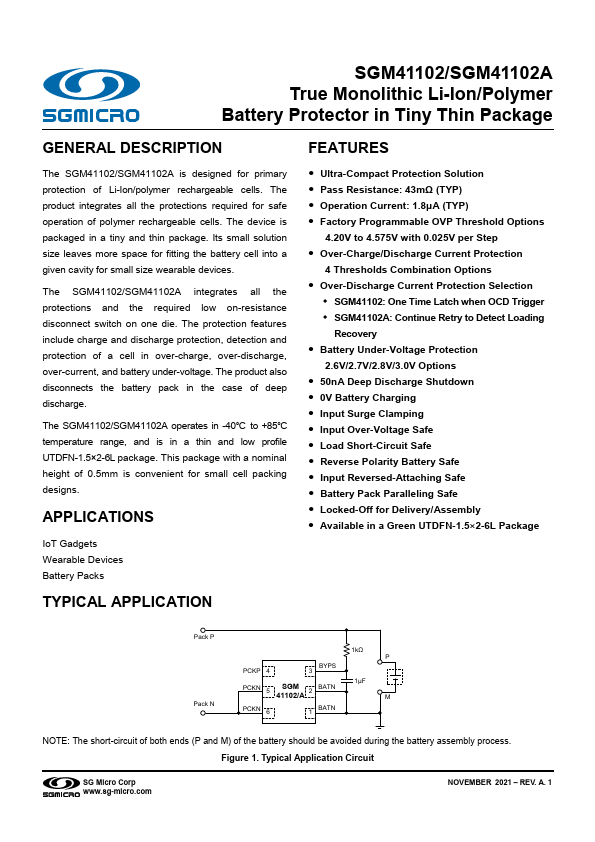
The SGM41102/SGM41102A is designed for primary protection of Li-Ion/polymer rechargeable cells.

The product integrates all the protections required for safe operation of polymer rechargeable cells.

The device is packaged in a tiny and thin package.

Features

  • include charge and discharge protection, detection and protection of a cell in over-charge, over-discharge, over-current, and battery under-voltage. The product also disconnects the battery pack in the case of deep discharge. The SGM41102/SGM41102A operates in -40℃ to +85℃ temperature range, and is in a thin and low profile UTDFN-1.5×2-6L package. This package with a nominal height of 0.5mm is convenient for small cell packing designs.

📥 Download Datasheet

Datasheet preview – SGM41102A

Datasheet Details

Part number SGM41102A
Manufacturer SG Micro
File Size 1.04 MB
Description True Monolithic Li-Ion/Polymer Battery Protector
Datasheet download datasheet SGM41102A Datasheet
Additional preview pages of the SGM41102A datasheet.
Other Datasheets by SG Micro

Full PDF Text Transcription

Click to expand full text
SGM41102/SGM41102A True Monolithic Li-Ion/Polymer Battery Protector in Tiny Thin Package GENERAL DESCRIPTION The SGM41102/SGM41102A is designed for primary protection of Li-Ion/polymer rechargeable cells. The product integrates all the protections required for safe operation of polymer rechargeable cells. The device is packaged in a tiny and thin package. Its small solution size leaves more space for fitting the battery cell into a given cavity for small size wearable devices. The SGM41102/SGM41102A integrates all the protections and the required low on-resistance disconnect switch on one die. The protection features include charge and discharge protection, detection and protection of a cell in over-charge, over-discharge, over-current, and battery under-voltage.
Published: |