Datasheet4U Logo Datasheet4U.com

BA5973FP - 3-channel BTL driver for CD/ CD-ROM/ DVD/ and DVD-ROM

Description

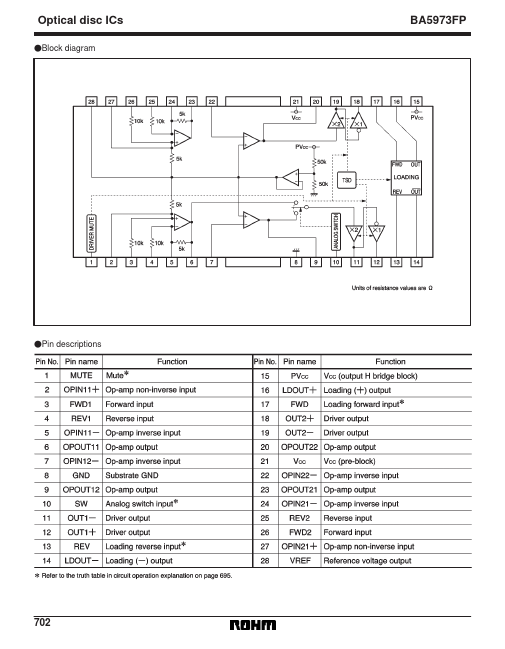
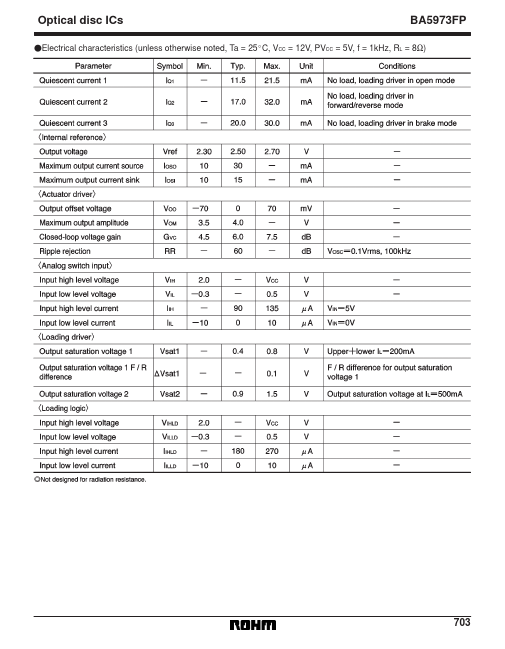
702 Optical disc ICs BA5973FP FElectrical characteristics (unless otherwise noted, Ta = 25_C, VCC = 12V, PVCC = 5V, f = 1kHz, RL = 8Ω) 703 Optical disc ICs FMeasurement circuit BA5973FP 704 Optical disc ICs FCircuit operation The analog switch pin 10, the mute pin 1, and the loading driver

Features

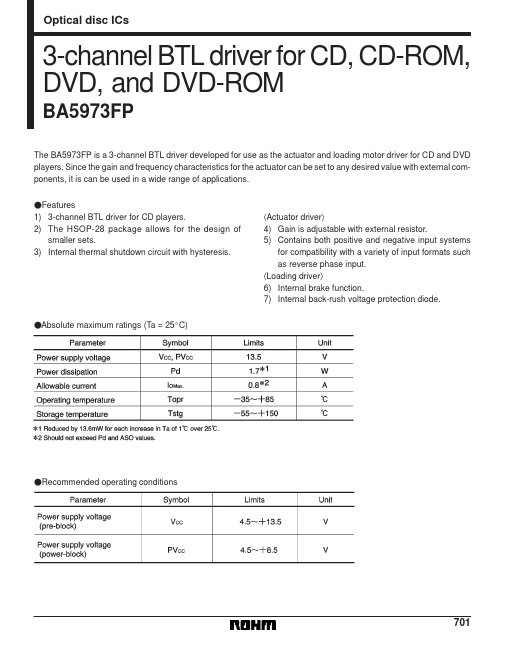
  • 1) 3-channel BTL driver for CD players. 2) The HSOP-28 package allows for the design of smaller sets. 3) Internal thermal shutdown circuit with hysteresis. 〈Actuator driver〉 4) Gain is adjustable with external resistor. 5) Contains both positive and negative input systems for compatibility with a variety of input formats such as reverse phase input. 〈Loading driver〉 6) Internal brake function. 7) Internal back-rush voltage protection diode. FAbsolute maximum ratings (Ta = 25_C) FRecommended o.

📥 Download Datasheet

Datasheet preview – BA5973FP

Datasheet Details

Part number BA5973FP
Manufacturer ROHM
File Size 137.32 KB
Description 3-channel BTL driver for CD/ CD-ROM/ DVD/ and DVD-ROM
Datasheet download datasheet BA5973FP Datasheet
Additional preview pages of the BA5973FP datasheet.
Other Datasheets by Rohm

Full PDF Text Transcription

Click to expand full text
Optical disc ICs 3-channel BTL driver for CD, CD-ROM, DVD, and DVD-ROM BA5973FP The BA5973FP is a 3-channel BTL driver developed for use as the actuator and loading motor driver for CD and DVD players. Since the gain and frequency characteristics for the actuator can be set to any desired value with external components, it is can be used in a wide range of applications. FFeatures 1) 3-channel BTL driver for CD players. 2) The HSOP-28 package allows for the design of smaller sets. 3) Internal thermal shutdown circuit with hysteresis. 〈Actuator driver〉 4) Gain is adjustable with external resistor. 5) Contains both positive and negative input systems for compatibility with a variety of input formats such as reverse phase input. 〈Loading driver〉 6) Internal brake function.

Published: |