Datasheet4U Logo Datasheet4U.com

RTQ2102B-QA - Synchronous Step-Down Converter

This page provides the datasheet information for the RTQ2102B-QA, a member of the RTQ2102A Synchronous Step-Down Converter family.

Datasheet Summary

Description

The RTQ2102A and RTQ2102B are 1.5A, high-efficiency, Advanced Constant-On-Time (ACOT® ) synchronous stepdown converters.

The device operates with input voltages from 3V to 6V.

The device can program the output voltage between 0.45V to VIN.

Features

  • AEC-Q100 Grade 1 Qualified.
  • Input Supply Voltage Range: 3V to 6V.
  • Output Voltage Range: 0.45V to VIN.
  • 1.5A Converter Integrated 110m and 90m FETS in WDFN-8L 3x3 Package.
  • Advanced Constant On-Time (ACOT®) Control.
  • Ultrafast Transient Response.
  • No Needs for External Compensations.
  • Optimized for Low-ESR Ceramic Output Capacitors.
  • Low Quiescent Current: 30A.
  • Steady Switching Frequency: 2.7MHz.
  • Automatic Power Saving Mode (PSM).
  • Input Un.

📥 Download Datasheet

Datasheet preview – RTQ2102B-QA

Datasheet Details

Part number RTQ2102B-QA
Manufacturer Richtek
File Size 1.32 MB
Description Synchronous Step-Down Converter
Datasheet download datasheet RTQ2102B-QA Datasheet
Additional preview pages of the RTQ2102B-QA datasheet.
Other Datasheets by Richtek

Full PDF Text Transcription

Click to expand full text
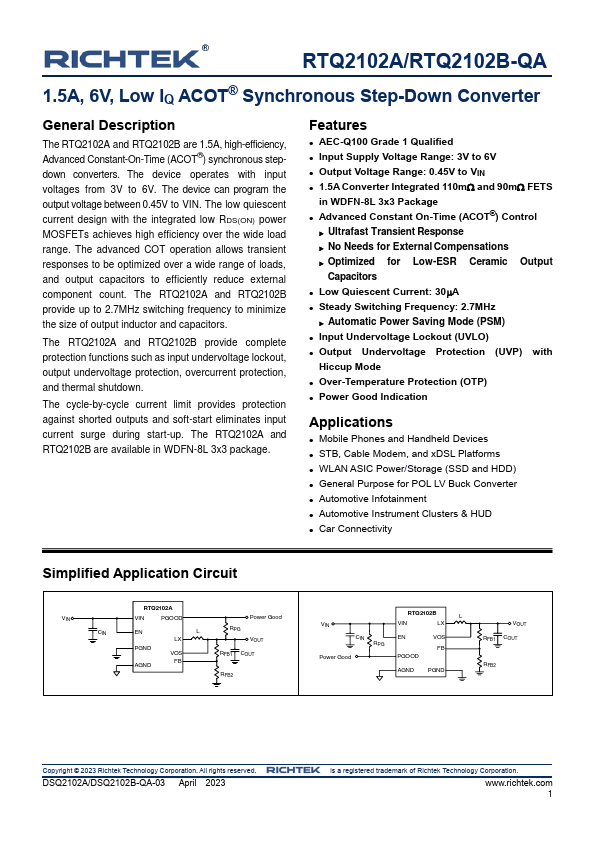
RTQ2102A/RTQ2102B-QA 1.5A, 6V, Low IQ ACOT® Synchronous Step-Down Converter General Description The RTQ2102A and RTQ2102B are 1.5A, high-efficiency, Advanced Constant-On-Time (ACOT® ) synchronous stepdown converters. The device operates with input voltages from 3V to 6V. The device can program the output voltage between 0.45V to VIN. The low quiescent current design with the integrated low RDS(ON) power MOSFETs achieves high efficiency over the wide load range. The advanced COT operation allows transient responses to be optimized over a wide range of loads, and output capacitors to efficiently reduce external component count. The RTQ2102A and RTQ2102B provide up to 2.7MHz switching frequency to minimize the size of output inductor and capacitors.
Published: |