Datasheet4U Logo Datasheet4U.com

RT9227A - Advanced PWM and Dual Fixed Linear Power Controller

Description

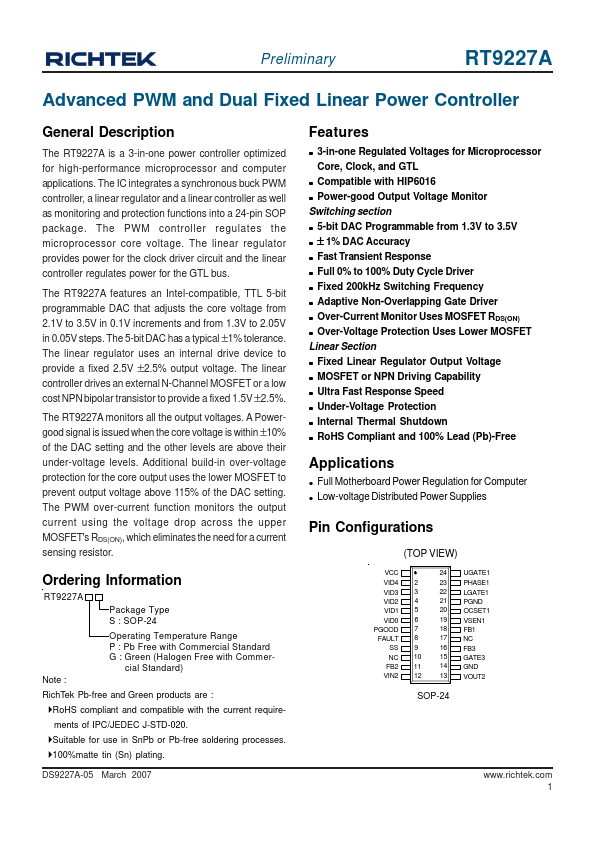
The RT9227A is a 3-in-one power controller optimized for high-performance microprocessor and computer applications.

The IC integrates a synchronous buck PWM controller, a linear regulator and a linear controller as well as monitoring and protection functions into a 24-pin SOP package.

Features

  • an Intel-compatible, TTL 5-bit programmable DAC that adjusts the core voltage from 2.1V to 3.5V in 0.1V increments and from 1.3V to 2.05V in 0.05V steps. The 5-bit DAC has a typical ±1% tolerance. The linear regulator uses an internal drive device to provide a fixed 2.5V ±2.5% output voltage. The linear controller drives an external N-Channel MOSFET or a low cost NPN bipolar transistor to provide a fixed 1.5V ±2.5%. The RT9227A monitors all the output voltages. A Power- good signal is issued whe.

📥 Download Datasheet

Datasheet preview – RT9227A

Datasheet Details

Part number RT9227A
Manufacturer Richtek
File Size 115.91 KB
Description Advanced PWM and Dual Fixed Linear Power Controller
Datasheet download datasheet RT9227A Datasheet
Additional preview pages of the RT9227A datasheet.
Other Datasheets by Richtek

Full PDF Text Transcription

Click to expand full text
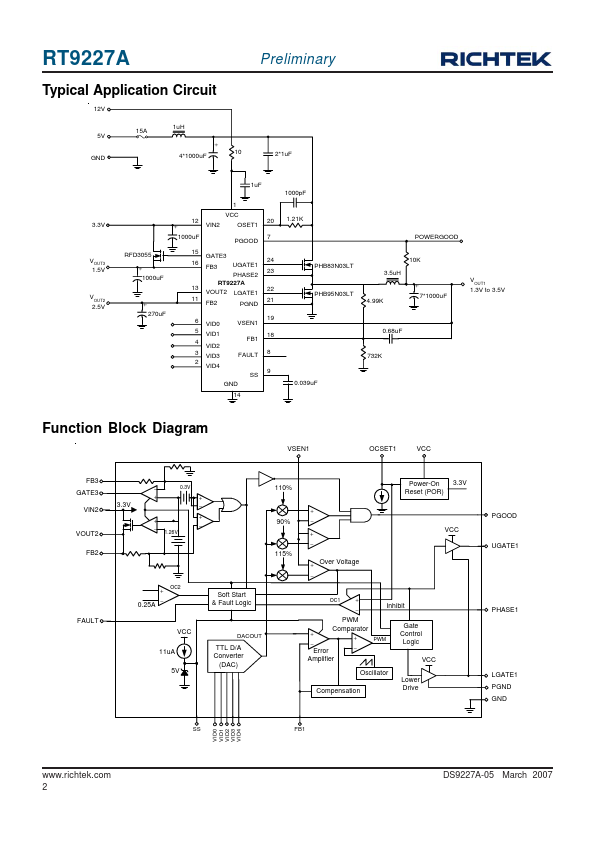
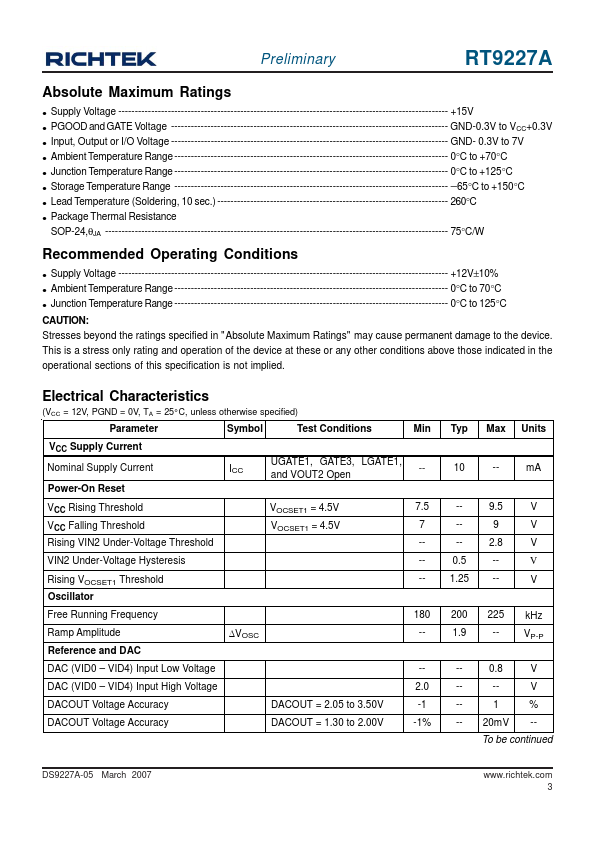
Preliminary RT9227A Advanced PWM and Dual Fixed Linear Power Controller General Description The RT9227A is a 3-in-one power controller optimized for high-performance microprocessor and computer applications. The IC integrates a synchronous buck PWM controller, a linear regulator and a linear controller as well as monitoring and protection functions into a 24-pin SOP package. The PWM controller regulates the microprocessor core voltage. The linear regulator provides power for the clock driver circuit and the linear controller regulates power for the GTL bus. The RT9227A features an Intel-compatible, TTL 5-bit programmable DAC that adjusts the core voltage from 2.1V to 3.5V in 0.1V increments and from 1.3V to 2.05V in 0.05V steps. The 5-bit DAC has a typical ±1% tolerance.
Published: |