Datasheet4U Logo Datasheet4U.com

RT5714 - 0.5A/1A HCOT nanoPower Buck Converter

This page provides the datasheet information for the RT5714, a member of the RT5713 0.5A/1A HCOT nanoPower Buck Converter family.

Datasheet Summary

Description

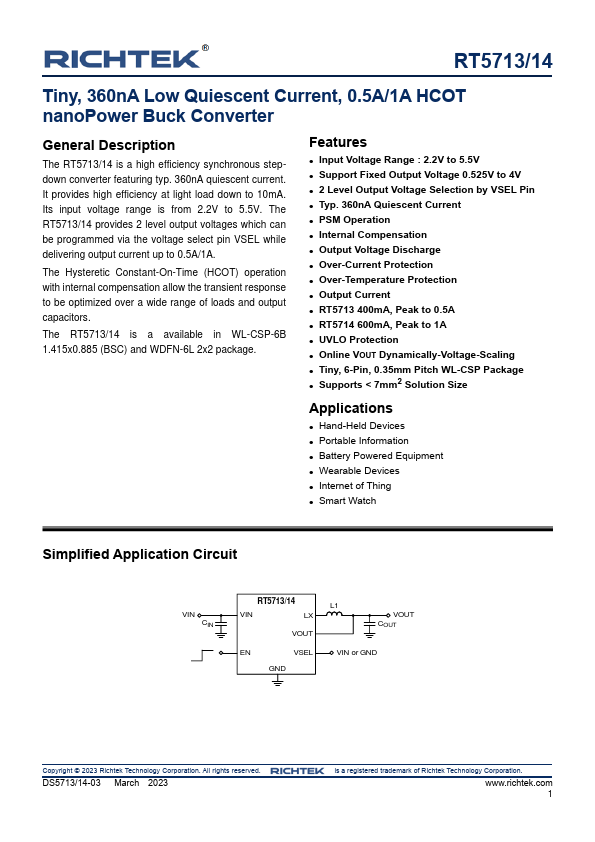
The RT5713/14 is a high efficiency synchronous stepdown converter featuring typ.

360nA quiescent current.

It provides high efficiency at light load down to 10mA.

Features

  • Input Voltage Range : 2.2V to 5.5V.
  • Support Fixed Output Voltage 0.525V to 4V.
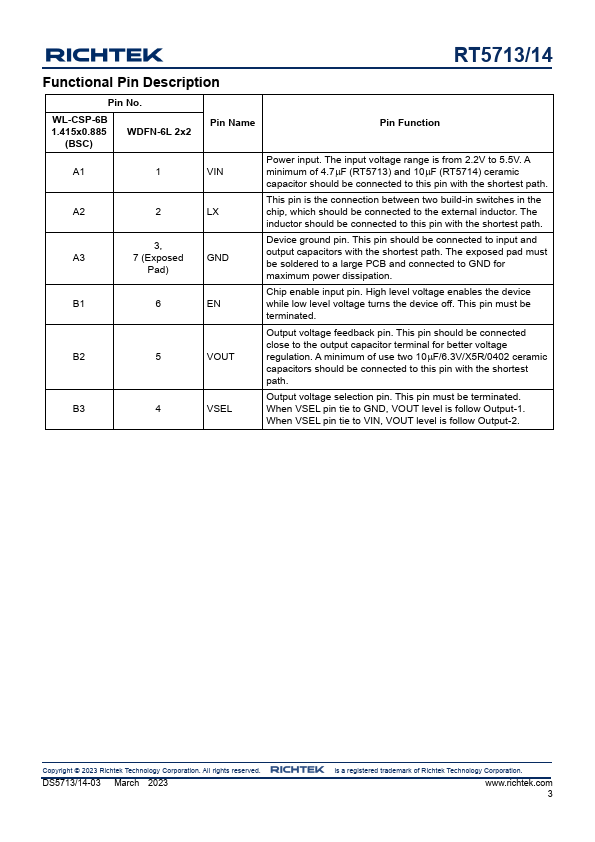
  • 2 Level Output Voltage Selection by VSEL Pin.
  • Typ. 360nA Quiescent Current.
  • PSM Operation.
  • Internal Compensation.
  • Output Voltage Discharge.
  • Over-Current Protection.
  • Over-Temperature Protection.
  • Output Current.
  • RT5713 400mA, Peak to 0.5A.
  • RT5714 600mA, Peak to 1A.
  • UVLO Protection.
  • Online VOUT Dynamically-Voltage-Scaling.
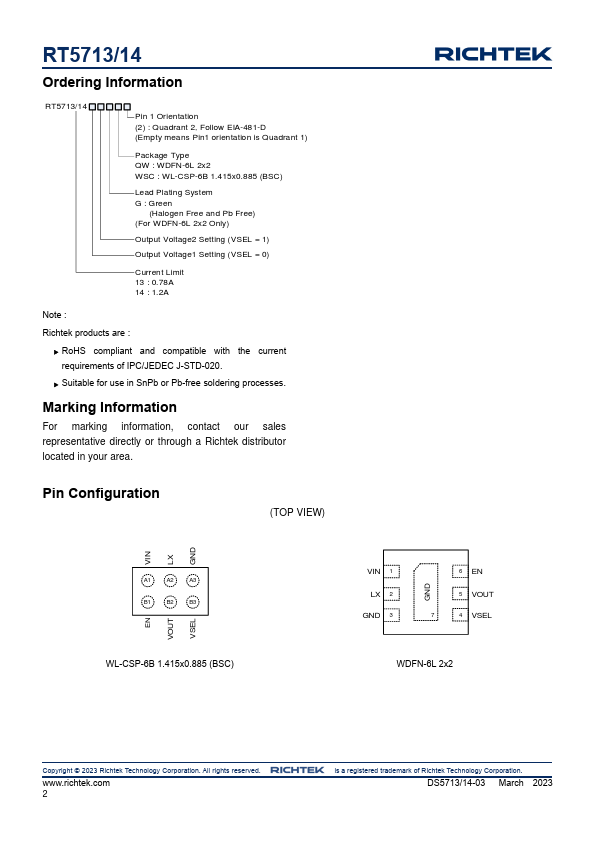
  • Tiny, 6-Pin, 0.35mm Pit.

📥 Download Datasheet

Datasheet preview – RT5714

Datasheet Details

Part number RT5714
Manufacturer Richtek
File Size 1.13 MB
Description 0.5A/1A HCOT nanoPower Buck Converter
Datasheet download datasheet RT5714 Datasheet
Additional preview pages of the RT5714 datasheet.
Other Datasheets by Richtek

Full PDF Text Transcription

Click to expand full text
RT5713/14 Tiny, 360nA Low Quiescent Current, 0.5A/1A HCOT nanoPower Buck Converter General Description The RT5713/14 is a high efficiency synchronous stepdown converter featuring typ. 360nA quiescent current. It provides high efficiency at light load down to 10mA. Its input voltage range is from 2.2V to 5.5V. The RT5713/14 provides 2 level output voltages which can be programmed via the voltage select pin VSEL while delivering output current up to 0.5A/1A. The Hysteretic Constant-On-Time (HCOT) operation with internal compensation allow the transient response to be optimized over a wide range of loads and output capacitors. The RT5713/14 is a available in WL-CSP-6B 1.415x0.885 (BSC) and WDFN-6L 2x2 package. Features ⚫ Input Voltage Range : 2.2V to 5.5V ⚫ Support Fixed Output Voltage 0.
Published: |