Datasheet4U Logo Datasheet4U.com

RT5091B - Power Management Unit Total Power Solution

This page provides the datasheet information for the RT5091B, a member of the RT5091A Power Management Unit Total Power Solution family.

Description

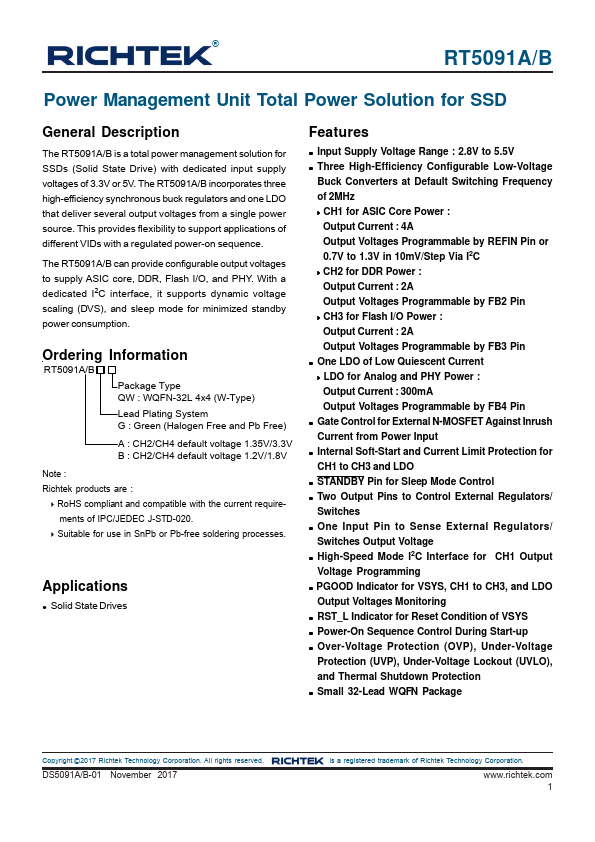
The RT5091A/B is a total power management solution for SSDs (Solid State Drive) with dedicated input supply voltages of 3.3V or 5V.

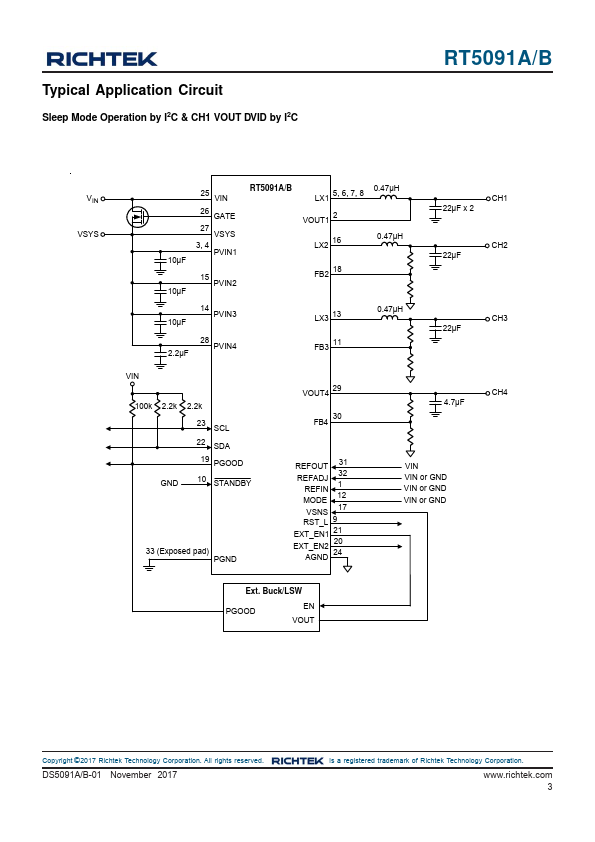
The RT5091A/B incorporates three high-efficiency synchronous buck regulators and one LDO that deliver several output voltages from a single power source.

Features

  • Input Supply Voltage Range : 2.8V to 5.5V.
  • Three High-Efficiency Configurable Low-Voltage Buck Converters at Default Switching Frequency of 2MHz  CH1 for ASIC Core Power : Output Current : 4A Output Voltages Programmable by REFIN Pin or 0.7V to 1.3V in 10mV/Step Via I2C  CH2 for DDR Power : Output Current : 2A Output Voltages Programmable by FB2 Pin  CH3 for Flash I/O Power : Output Current : 2A Output Voltages Programmable by FB3 Pin.
  • One LDO of Low Quiescent Current  LDO fo.

📥 Download Datasheet

Datasheet preview – RT5091B

Datasheet Details

Part number RT5091B
Manufacturer Richtek
File Size 787.80 KB
Description Power Management Unit Total Power Solution
Datasheet download datasheet RT5091B Datasheet
Additional preview pages of the RT5091B datasheet.
Other Datasheets by Richtek

Full PDF Text Transcription

Click to expand full text
® RT5091A/B Power Management Unit Total Power Solution for SSD General Description The RT5091A/B is a total power management solution for SSDs (Solid State Drive) with dedicated input supply voltages of 3.3V or 5V. The RT5091A/B incorporates three high-efficiency synchronous buck regulators and one LDO that deliver several output voltages from a single power source. This provides flexibility to support applications of different VIDs with a regulated power-on sequence. The RT5091A/B can provide configurable output voltages to supply ASIC core, DDR, Flash I/O, and PHY. With a dedicated I2C interface, it supports dynamic voltage scaling (DVS), and sleep mode for minimized standby power consumption.
Published: |