
Datasheet Details
| Part number | 74F544 |
|---|---|
| Manufacturer | Philips Semiconductors (now NXP Semiconductors) |
| File Size | 149.48 KB |
| Description | Octal registered transceiver |
| Datasheet |
 74F544 Datasheet 74F544 Datasheet
|
|
|

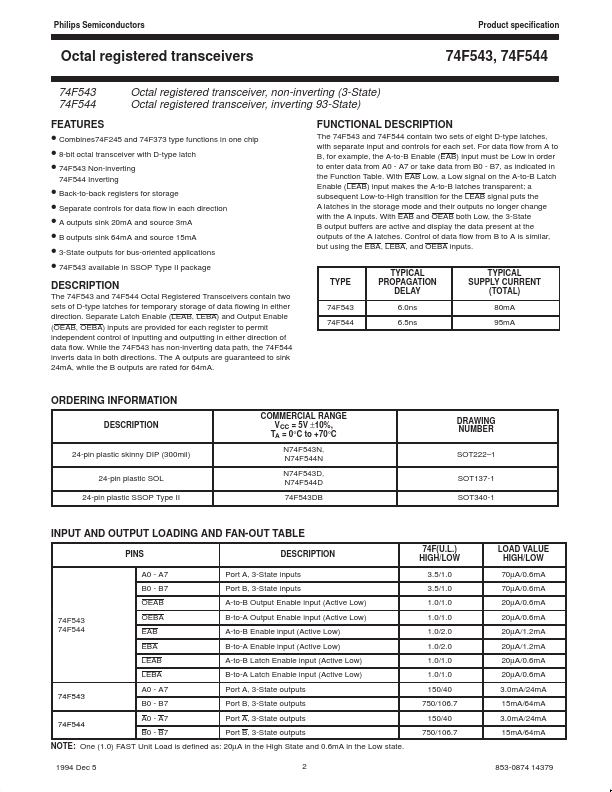
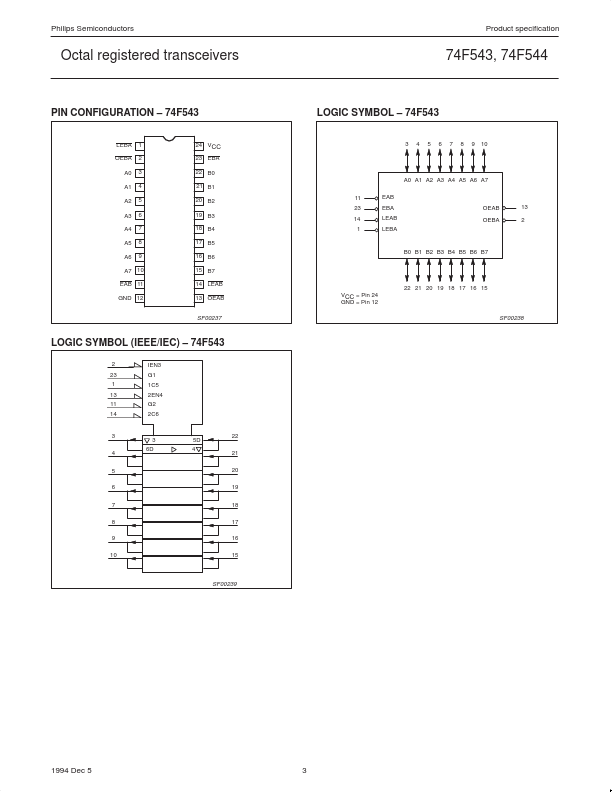
The 74F543 and 74F544 contain two sets of eight D-type latches, with separate input and controls for each set.
For data flow from A to B, for example, the A-to-B Enable (EAB) input must be Low in order to enter data from A0 - A7 or take data from B0 - B7, as indicated in the Function Table.
| Part number | 74F544 |
|---|---|
| Manufacturer | Philips Semiconductors (now NXP Semiconductors) |
| File Size | 149.48 KB |
| Description | Octal registered transceiver |
| Datasheet |
74F544 Datasheet
|
|
|
|
| Part Number | Description | Manufacturer |
|---|---|---|
| 74F544 | Octal Registered Transceiver | Fairchild |
| 74F544 | Octal Registered Transceiver | National |
| 74F540 | Octal Buffer/Line Driver | Fairchild |
| 74F540 | Octal Buffer/Line Driver | National |
| 74F541 | Octal Buffer/Line Driver | Fairchild |
| Part Number | Description |
|---|---|
| 74F540 | Octal inverter buffer |
| 74F541 | Octal inverter buffer |
| 74F543 | Octal registered transceiver |
| 74F545 | Octal bidirectional transceiver |
| 74F50109 | Synchronizing dual J-K positive edge-triggered flip-flop |
The following content is an automatically extracted verbatim text from the original manufacturer datasheet and is provided for reference purposes only.