
Datasheet Details
| Part number | NV25040MUW |
|---|---|
| Manufacturer | onsemi |
| File Size | 227.65 KB |
| Description | EEPROM |
| Datasheet |
 NV25040MUW Datasheet NV25040MUW Datasheet
|
|
|

Download the NV25040MUW datasheet PDF. This datasheet also covers the NV25010MUW variant, as both devices belong to the same eeprom family and are provided as variant models within a single manufacturer datasheet.
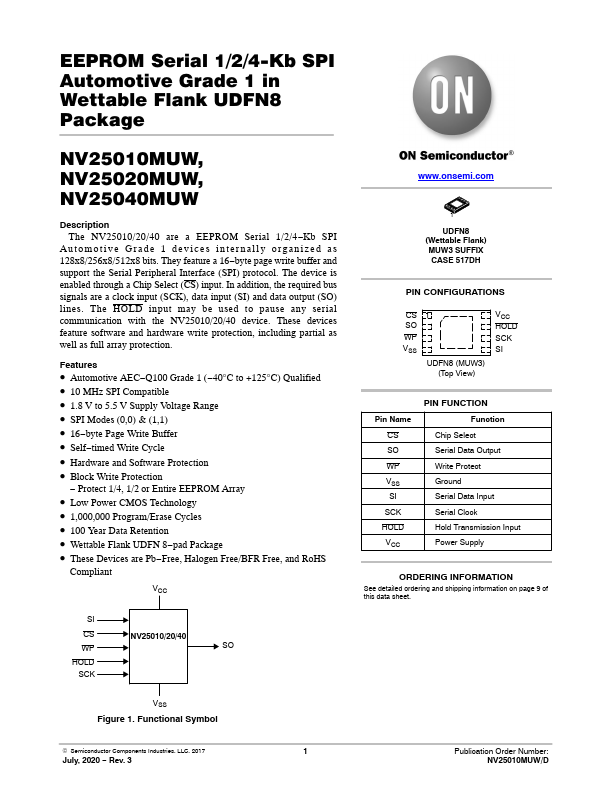
Automotive Grade 1 devices internally organized as 128x8/256x8/512x8 bits.
byte page write buffer and support the Serial Peripheral Interface (SPI) protocol.
The device is enabled through a Chip Select (CS) input.
| Part number | NV25040MUW |
|---|---|
| Manufacturer | onsemi |
| File Size | 227.65 KB |
| Description | EEPROM |
| Datasheet |
NV25040MUW Datasheet
|
|
|
|
| Part Number | Description | Manufacturer |
|---|---|---|
| NV20FP | G-LOW CURRENT HIGH VOLTAGE RECTIFIERS | HV Component Associates |
| NV231 | light weight | DB Lectro |
| NV2M | light weight | DB Lectro |
| Part Number | Description |
|---|---|
| NV25040 | EEPROM |
| NV25040LV | EEPROM |
| NV25010 | EEPROM |
| NV25010LV | EEPROM |
| NV25010MUW | EEPROM |
The following content is an automatically extracted verbatim text from the original manufacturer datasheet and is provided for reference purposes only.