Datasheet4U Logo Datasheet4U.com

NCP4355C - Secondary Side SMPS Controller

Download the NCP4355C datasheet PDF. This datasheet also covers the NCP4355 variant, as both devices belong to the same secondary side smps controller family and are provided as variant models within a single manufacturer datasheet.

Description

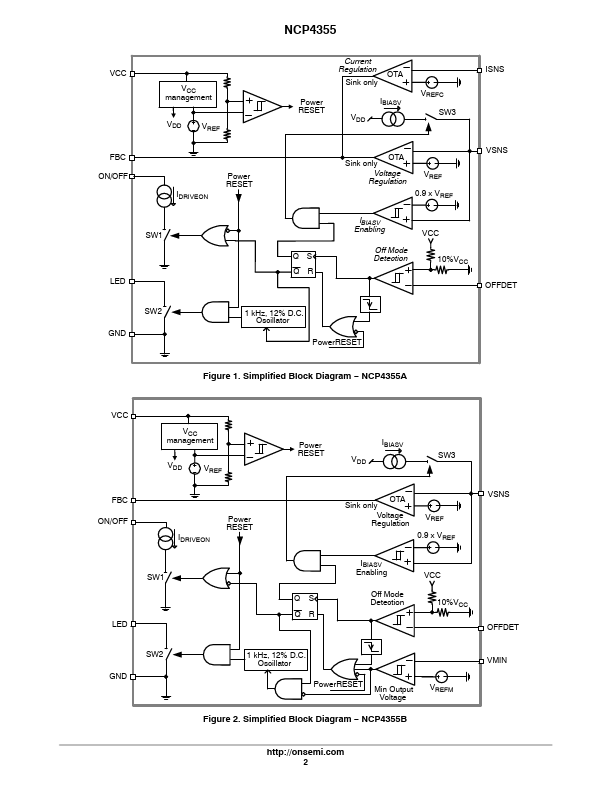
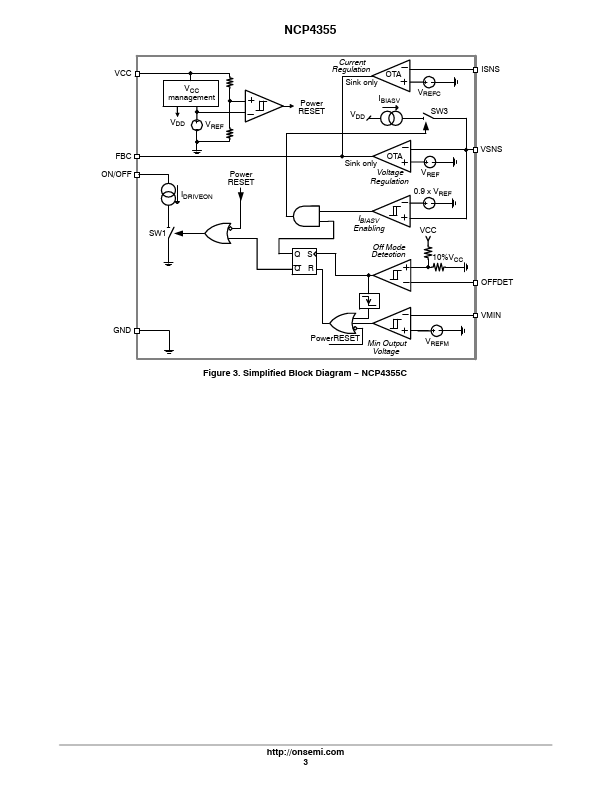
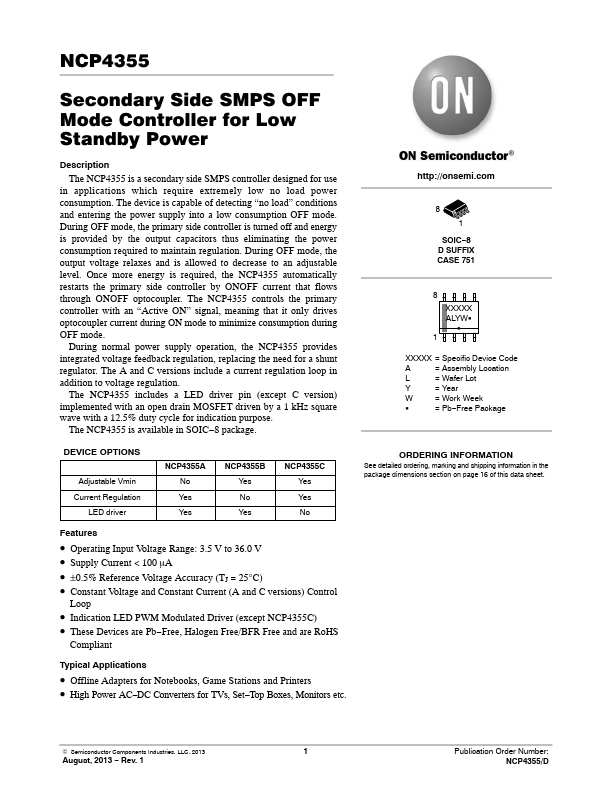
The NCP4355 is a secondary side SMPS controller designed for use in applications which require extremely low no load power consumption.

The device is capable of detecting “no load” conditions and entering the power supply into a low consumption OFF mode.

Features

  • Operating Input Voltage Range: 3.5 V to 36.0 V.
  • Supply Current < 100 mA.
  • ±0.5% Reference Voltage Accuracy (TJ = 25°C).
  • Constant Voltage and Constant Current (A and C versions) Control Loop.
  • Indication LED PWM Modulated Driver (except NCP4355C).
  • These Devices are Pb.
  • Free, Halogen Free/BFR Free and are RoHS Compliant Typical.

📥 Download Datasheet

Note: The manufacturer provides a single datasheet file (NCP4355_ONSemiconductor.pdf) that lists specifications for multiple related part numbers.

Datasheet Details

Part number NCP4355C
Manufacturer onsemi
File Size 196.83 KB
Description Secondary Side SMPS Controller
Datasheet download datasheet NCP4355C Datasheet

Full PDF Text Transcription

Click to expand full text
NCP4355 Secondary Side SMPS OFF Mode Controller for Low Standby Power Description The NCP4355 is a secondary side SMPS controller designed for use in applications which require extremely low no load power consumption. The device is capable of detecting “no load” conditions and entering the power supply into a low consumption OFF mode. During OFF mode, the primary side controller is turned off and energy is provided by the output capacitors thus eliminating the power consumption required to maintain regulation. During OFF mode, the output voltage relaxes and is allowed to decrease to an adjustable level. Once more energy is required, the NCP4355 automatically restarts the primary side controller by ONOFF current that flows through ONOFF optocoupler.

Published: |