Datasheet4U Logo Datasheet4U.com

NTE4022B - 5-stage and 4-stage Johnson counters

Download the NTE4022B datasheet PDF. This datasheet also covers the NTE4017B variant, as both devices belong to the same 5-stage and 4-stage johnson counters family and are provided as variant models within a single manufacturer datasheet.

Description

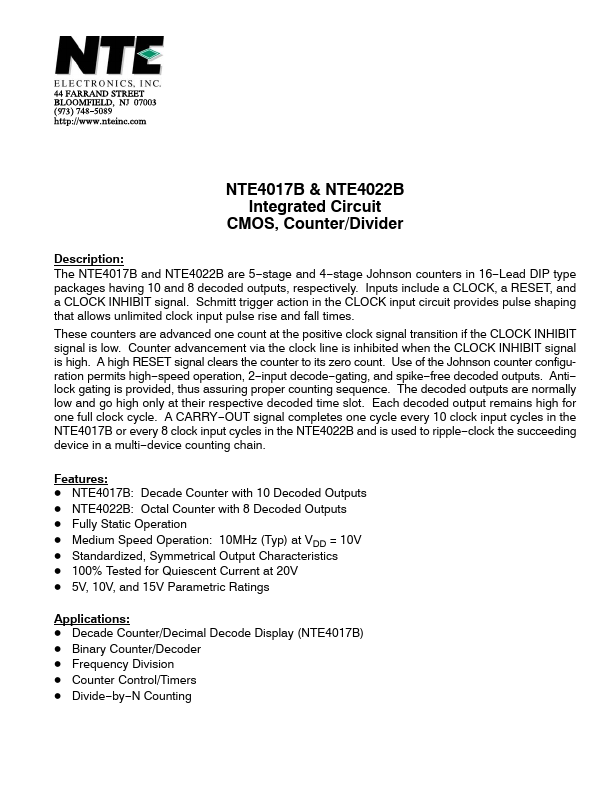
The NTE4017B and NTE4022B are 5 stage and 4 stage Johnson counters in 16

Lead DIP type packages having 10 and 8 decoded outputs, respectively.

Inputs include a CLOCK, a RESET, and a CLOCK INHIBIT signal.

Features

  • D NTE4017B: Decade Counter with 10 Decoded Outputs D NTE4022B: Octal Counter with 8 Decoded Outputs D Fully Static Operation D Medium Speed Operation: 10MHz (Typ) at VDD = 10V D Standardized, Symmetrical Output Characteristics D 100% Tested for Quiescent Current at 20V D 5V, 10V, and 15V Parametric Ratings.

📥 Download Datasheet

Note: The manufacturer provides a single datasheet file (NTE4017B-NTEElectronics.pdf) that lists specifications for multiple related part numbers.

Datasheet Details

Part number NTE4022B
Manufacturer NTE Electronics (defunct)
File Size 67.50 KB
Description 5-stage and 4-stage Johnson counters
Datasheet download datasheet NTE4022B Datasheet

Full PDF Text Transcription

Click to expand full text
NTE4017B & NTE4022B Integrated Circuit CMOS, Counter/Divider Description: The NTE4017B and NTE4022B are 5−stage and 4−stage Johnson counters in 16−Lead DIP type packages having 10 and 8 decoded outputs, respectively. Inputs include a CLOCK, a RESET, and a CLOCK INHIBIT signal. Schmitt trigger action in the CLOCK input circuit provides pulse shaping that allows unlimited clock input pulse rise and fall times. These counters are advanced one count at the positive clock signal transition if the CLOCK INHIBIT signal is low. Counter advancement via the clock line is inhibited when the CLOCK INHIBIT signal is high. A high RESET signal clears the counter to its zero count. Use of the Johnson counter configuration permits high−speed operation, 2−input decode−gating, and spike−free decoded outputs.

Published: |