
Datasheet Details
| Part number | MP3430HQ |
|---|---|
| Manufacturer | Monolithic Power Systems |
| File Size | 1.00 MB |
| Description | 90V Step-Up Converter |
| Datasheet |
 MP3430HQ Datasheet MP3430HQ Datasheet
|
|
|

Download the MP3430HQ datasheet PDF. This datasheet also covers the MP3430 variant, as both devices belong to the same 90v step-up converter family and are provided as variant models within a single manufacturer datasheet.
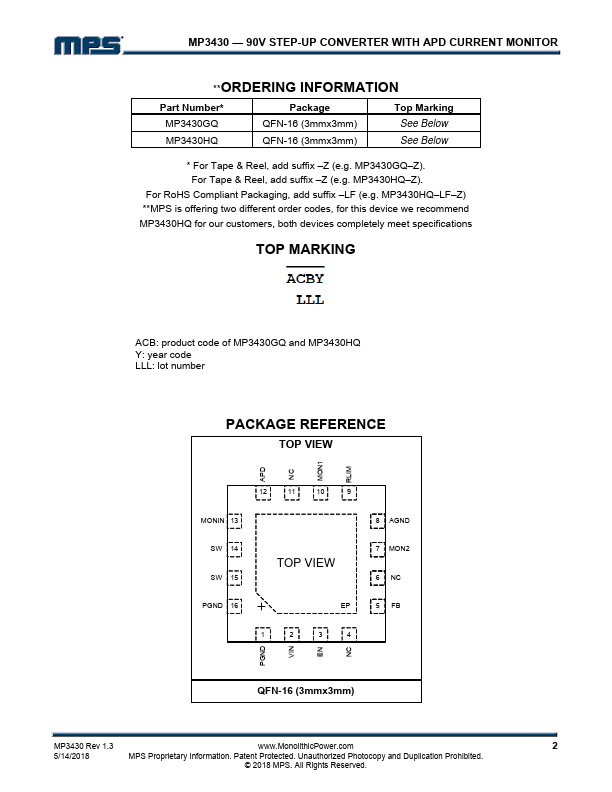
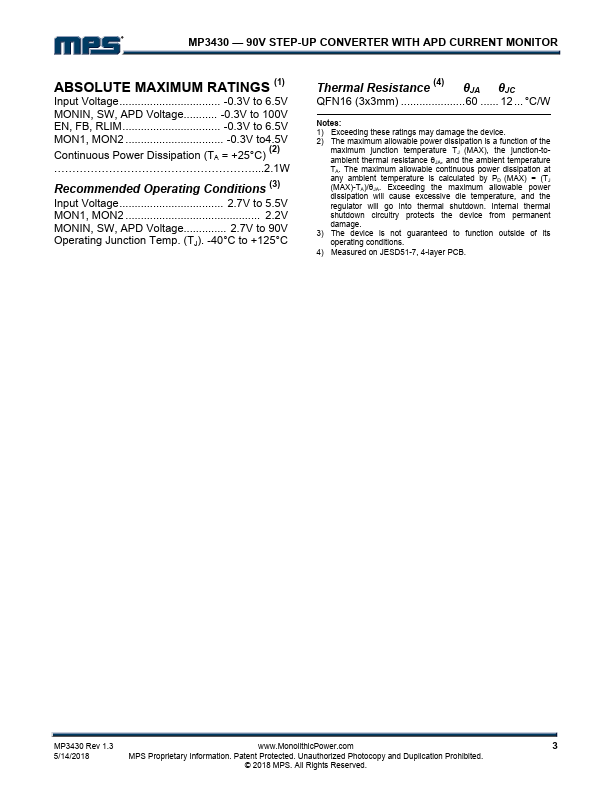
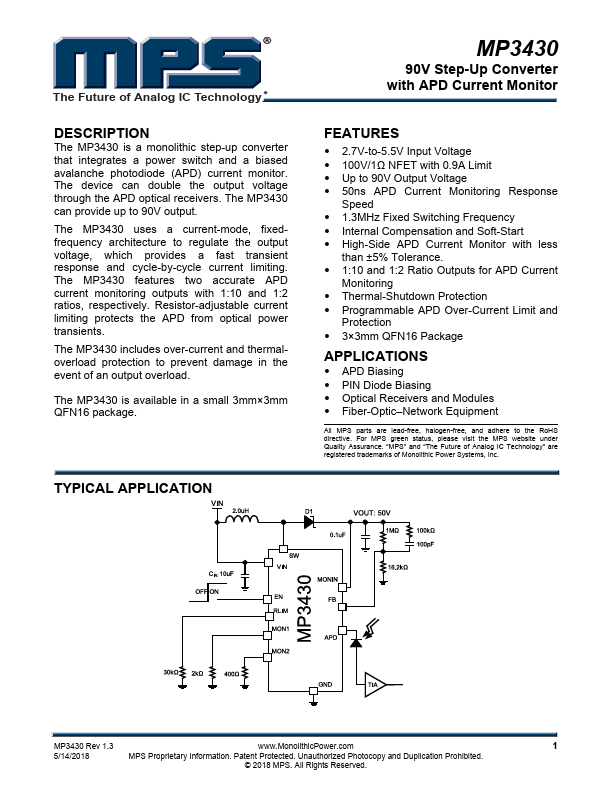
The MP3430 is a monolithic step-up converter that integrates a power switch and a biased avalanche photodiode (APD) current monitor.
The device can double the output voltage through the APD optical receivers.
The MP3430 can provide up to 90V output.
| Part number | MP3430HQ |
|---|---|
| Manufacturer | Monolithic Power Systems |
| File Size | 1.00 MB |
| Description | 90V Step-Up Converter |
| Datasheet |
MP3430HQ Datasheet
|
|
|
|
| Part Number | Description |
|---|---|
| MP3430 | 90V Step-Up Converter |
| MP3430GQ | 90V Step-Up Converter |
| MP3432 | 30W Boost Converter |
| MP3432GL | 30W Boost Converter |
| MP3435 | Synchronous Boost Converter |
| MP3435GL | Synchronous Boost Converter |
| MP3437 | Synchronous Boost Converter |
| MP3437GJ | Synchronous Boost Converter |
| MP3437GRP | Synchronous Boost Converter |
| MP3414 | Step-up Converter |
The following content is an automatically extracted verbatim text from the original manufacturer datasheet and is provided for reference purposes only.