Datasheet4U Logo Datasheet4U.com

HD45H11 - PNP EPITAXIAL PLANAR TRANSISTOR

This page provides the datasheet information for the HD45H11, a member of the HD45H11_Hi PNP EPITAXIAL PLANAR TRANSISTOR family.

Datasheet Summary

Description

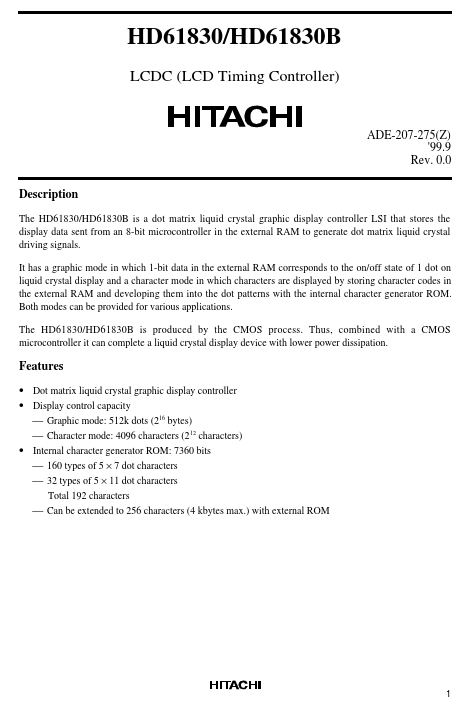
The HD61830/HD61830B is a dot matrix liquid crystal graphic display controller LSI that stores the display data sent from an 8-bit microcontroller in the external RAM to generate dot matrix liquid crystal driving signals.

Features

  • Dot matrix liquid crystal graphic display controller.
  • Display control capacity  Graphic mode: 512k dots (216 bytes)  Character mode: 4096 characters (212 characters).
  • Internal character generator ROM: 7360 bits  160 types of 5 × 7 dot characters  32 types of 5 × 11 dot characters Total 192 characters  Can be extended to 256 characters (4 kbytes max. ) with external ROM 1 HD61830/HD61830B.
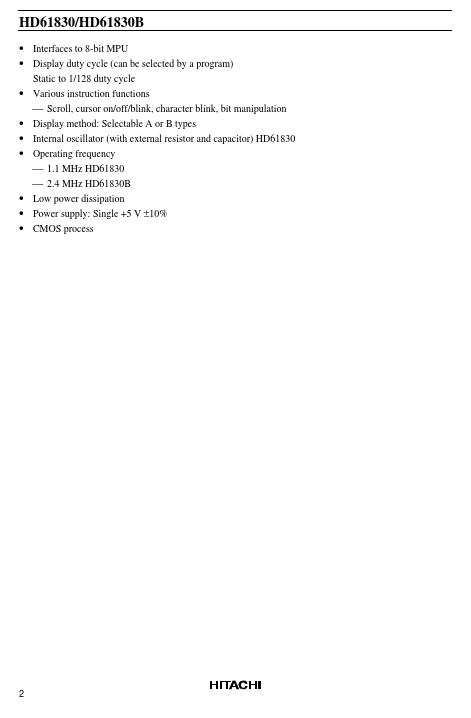
  • Interfaces to 8-bit MPU.
  • Display duty cycle (can be sele.

📥 Download Datasheet

Datasheet preview – HD45H11

Datasheet Details

Part number HD45H11
Manufacturer Hi-Sincerity Mocroelectronics
File Size 173.76 KB
Description PNP EPITAXIAL PLANAR TRANSISTOR
Datasheet download datasheet HD45H11 Datasheet
Additional preview pages of the HD45H11 datasheet.
Other Datasheets by Hi-Sincerity Mocroelectronics

Full PDF Text Transcription

Click to expand full text
HD61830/HD61830B LCDC (LCD Timing Controller) ADE-207-275(Z) '99.9 Rev. 0.0 Description The HD61830/HD61830B is a dot matrix liquid crystal graphic display controller LSI that stores the display data sent from an 8-bit microcontroller in the external RAM to generate dot matrix liquid crystal driving signals. It has a graphic mode in which 1-bit data in the external RAM corresponds to the on/off state of 1 dot on liquid crystal display and a character mode in which characters are displayed by storing character codes in the external RAM and developing them into the dot patterns with the internal character generator ROM. Both modes can be provided for various applications. The HD61830/HD61830B is produced by the CMOS process.
Published: |