Datasheet4U Logo Datasheet4U.com

S1C63616 - 4-bit Single Chip Microcontroller

Description

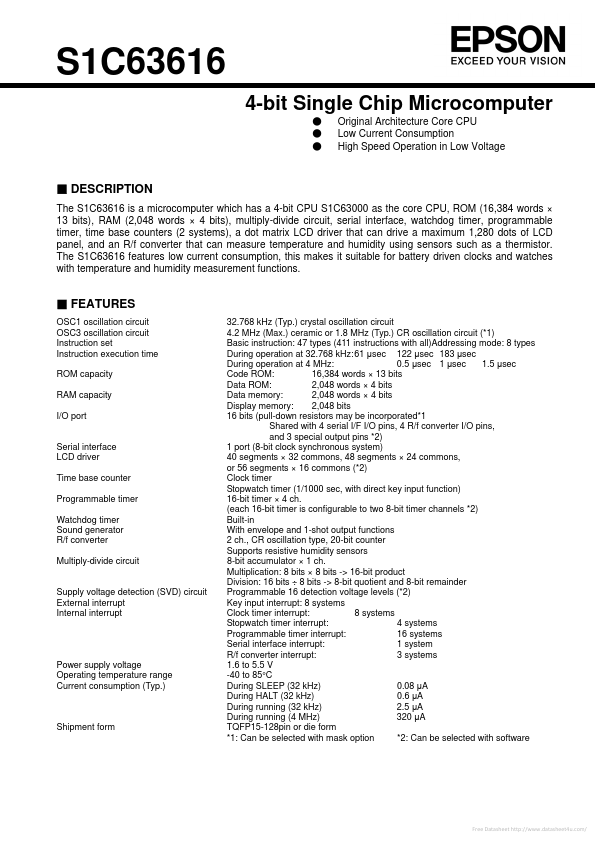
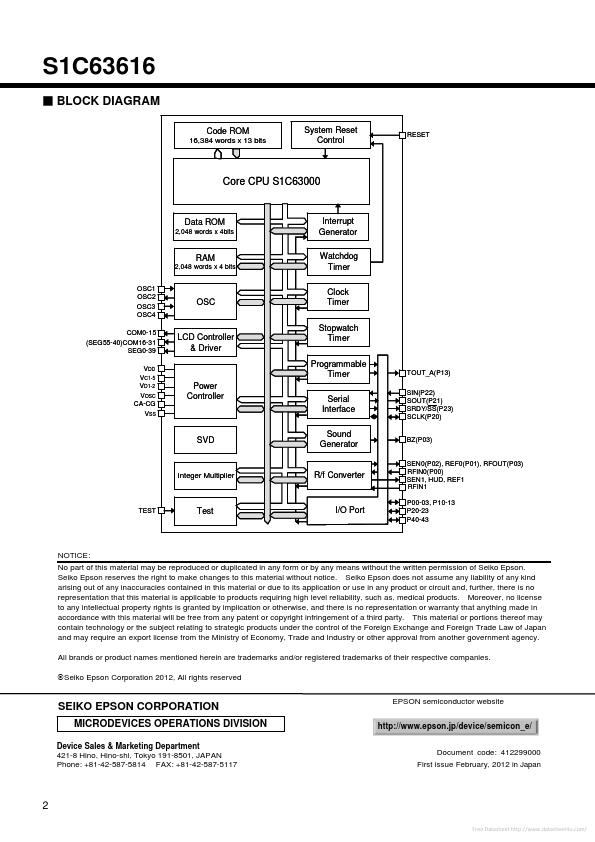
The S1C63616 is a microcomputer which has a 4-bit CPU S1C63000 as the core CPU, ROM (16,384 words × 13 bits), RAM (2,048 words × 4 bits), multiply-divide circuit, serial interface, watchdog timer, programmable timer, time base counters (2 systems), a dot matrix LCD driver that can drive a maximum 1,

Features

  • OSC1 oscillation circuit OSC3 oscillation circuit Instruction set Instruction execution time ROM capacity RAM capacity I/O port 32.768 kHz (Typ. ) crystal oscillation circuit 4.2 MHz (Max. ) ceramic or 1.8 MHz (Typ. ) CR oscillation circuit (.
  • 1) Basic instruction: 47 types (411 instructions with all)Addressing mode: 8 types During operation at 32.768 kHz: 61 μsec 122 μsec 183 μsec During operation at 4 MHz: 0.5 μsec 1 μsec 1.5 μsec Code ROM: 16,384 words × 13 bits Data ROM: 2,048 words × 4 bits.

📥 Download Datasheet

Datasheet Details

Part number S1C63616
Manufacturer Epson
File Size 156.75 KB
Description 4-bit Single Chip Microcontroller
Datasheet download datasheet S1C63616 Datasheet

Full PDF Text Transcription (Reference)

The following content is an automatically extracted verbatim text from the original manufacturer datasheet and is provided for reference purposes only.

View original datasheet text
S1C63616 4-bit Single Chip Microcomputer ● ● ● Original Architecture Core CPU Low Current Consumption High Speed Operation in Low Voltage „ DESCRIPTION The S1C63616 is a microcomputer which has a 4-bit CPU S1C63000 as the core CPU, ROM (16,384 words × 13 bits), RAM (2,048 words × 4 bits), multiply-divide circuit, serial interface, watchdog timer, programmable timer, time base counters (2 systems), a dot matrix LCD driver that can drive a maximum 1,280 dots of LCD panel, and an R/f converter that can measure temperature and humidity using sensors such as a thermistor. The S1C63616 features low current consumption, this makes it suitable for battery driven clocks and watches with temperature and humidity measurement functions.

Published: |