Datasheet4U Logo Datasheet4U.com

SED1530D0 - DOT MATRIX LCD CONTROLLER DRIVER

Download the SED1530D0 datasheet PDF. This datasheet also covers the SED variant, as both devices belong to the same dot matrix lcd controller driver family and are provided as variant models within a single manufacturer datasheet.

Description

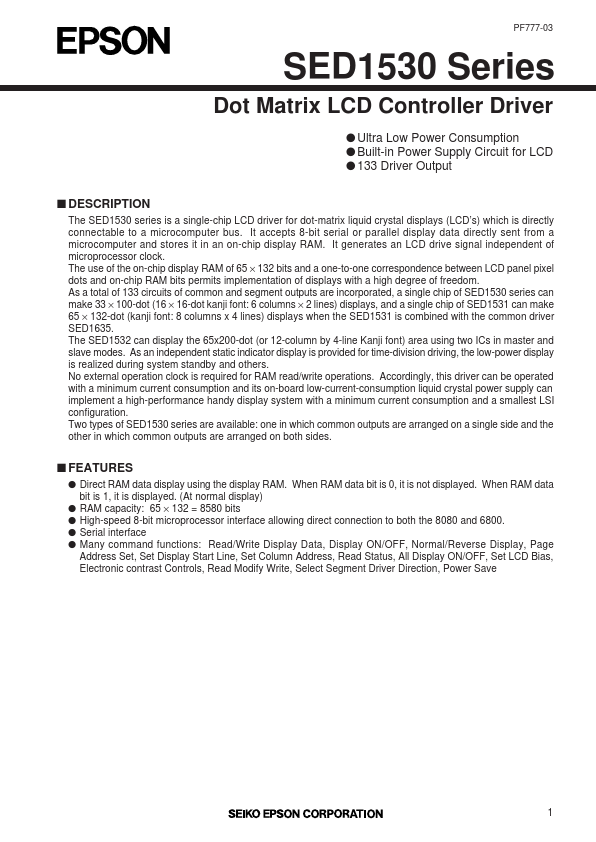
The SED1530 series is a single-chip LCD driver for dot-matrix liquid crystal displays (LCD’s) which is directly connectable to a microcomputer bus.

It accepts 8-bit serial or parallel display data directly sent from a microcomputer and stores it in an on-chip display RAM.

Features

  • q Direct RAM data display using the display RAM. When RAM data bit is 0, it is not displayed. When RAM data bit is 1, it is displayed. (At normal display) q RAM capacity: 65 × 132 = 8580 bits q High-speed 8-bit microprocessor interface allowing direct connection to both the 8080 and 6800. q Serial interface q Many command functions: Read/Write Display Data, Display ON/OFF, Normal/Reverse Display, Page Address Set, Set Display Start Line, Set Column Address, Read Status, All Display ON/OFF, Set L.

📥 Download Datasheet

Note: The manufacturer provides a single datasheet file (SED-1530.pdf) that lists specifications for multiple related part numbers.

Datasheet Details

Part number SED1530D0
Manufacturer Epson Company
File Size 176.00 KB
Description DOT MATRIX LCD CONTROLLER DRIVER
Datasheet download datasheet SED1530D0 Datasheet

Full PDF Text Transcription

Click to expand full text
PF777-03 SED1530 Series SED1530 Series Dot Matrix LCD Controller Driver SSC5000Series q Ultra Low Power Consumption q Built-in Power Supply Circuit for LCD q 133 Driver Output s DESCRIPTION The SED1530 series is a single-chip LCD driver for dot-matrix liquid crystal displays (LCD’s) which is directly connectable to a microcomputer bus. It accepts 8-bit serial or parallel display data directly sent from a microcomputer and stores it in an on-chip display RAM. It generates an LCD drive signal independent of microprocessor clock. The use of the on-chip display RAM of 65 × 132 bits and a one-to-one correspondence between LCD panel pixel dots and on-chip RAM bits permits implementation of displays with a high degree of freedom.

Published: |