
Datasheet Details
| Part number | CY7C1526JV18 |
|---|---|
| Manufacturer | Cypress (Infineon) |
| File Size | 719.20 KB |
| Description | 72-Mbit QDR-II SRAM 4-Word Burst Architecture |
| Datasheet |
 CY7C1526JV18 Datasheet CY7C1526JV18 Datasheet
|
|
|

Download the CY7C1526JV18 datasheet PDF. This datasheet also covers the CY7C1511JV18 variant, as both devices belong to the same 72-mbit qdr-ii sram 4-word burst architecture family and are provided as variant models within a single manufacturer datasheet.
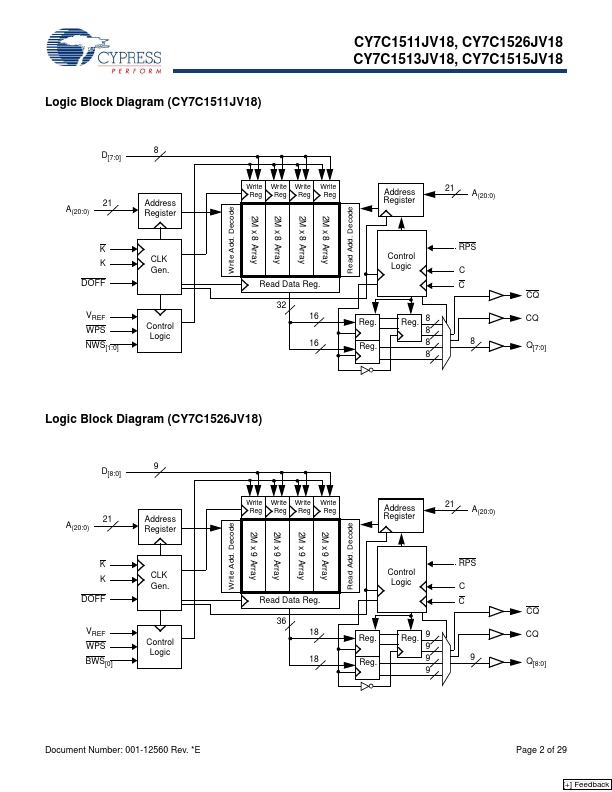
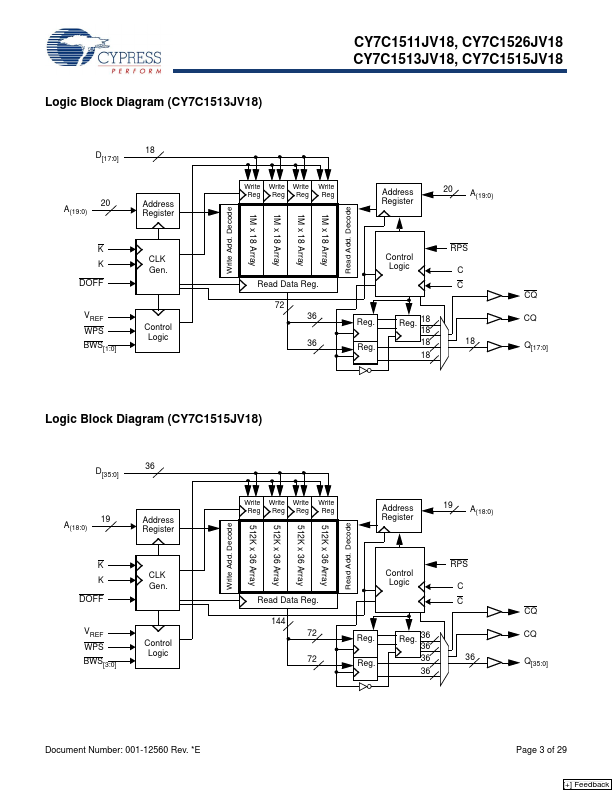
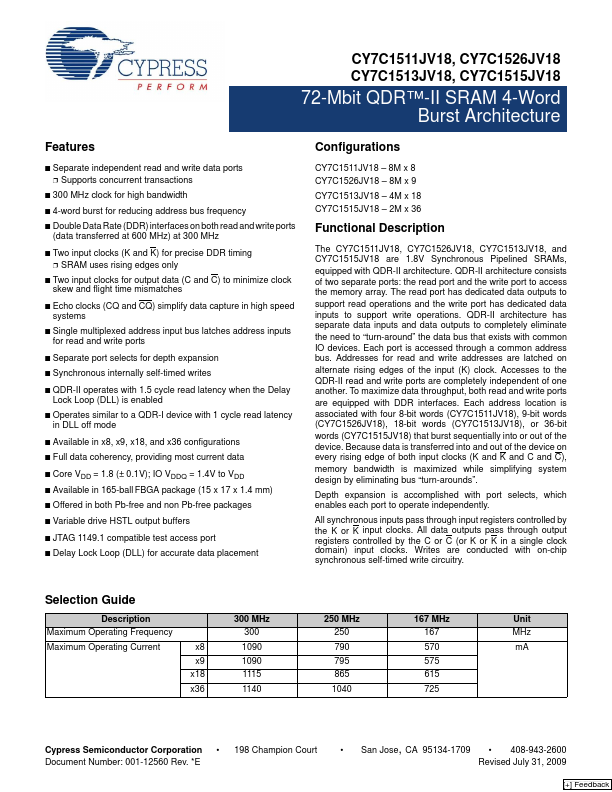
The CY7C1511JV18, CY7C1526JV18, CY7C1513JV18, and CY7C1515JV18 are 1.8V Synchronous Pipelined SRAMs, equipped with QDR-II architecture.
QDR-II architecture consists of two separate ports: the read port and the write port to access the memory array.
| Part number | CY7C1526JV18 |
|---|---|
| Manufacturer | Cypress (Infineon) |
| File Size | 719.20 KB |
| Description | 72-Mbit QDR-II SRAM 4-Word Burst Architecture |
| Datasheet |
CY7C1526JV18 Datasheet
|
|
|
|
| Part Number | Description | Manufacturer |
|---|---|---|
| CY7C1520AV18 | 72-Mbit DDR-II SRAM | Cypress |
| CY7C1518AV18 | 72-Mbit DDR-II SRAM | Cypress |
| CY7C1006D | 1-Mbit (256K x 4) Static RAM | Cypress |
| CY7C1011G | 2-Mbit (128K words x 16 bit) Static RAM | Cypress |
| CY7C1041G | 4-Mbit (256K words x 16 bit) Static RAM | Cypress |
| Part Number | Description |
|---|---|
| CY7C1526AV18 | 72-Mbit QDR-II SRAM 4-Word Burst Architecture |
| CY7C1526KV18 | 72-Mbit QDR-II SRAM Four-Word Burst Architecture |
| CY7C1526V18 | (CY7C15xxV18) SRAM 4-Word Burst Architecture |
| CY7C1520KV18 | 72-Mbit DDR-II SRAM Two-Word Burst Architecture |
| CY7C1520V18 | 1.8V Synchronous Pipelined SRAM |
The following content is an automatically extracted verbatim text from the original manufacturer datasheet and is provided for reference purposes only.