
Datasheet Details
| Part number | 74HC237D |
|---|---|
| Manufacturer | Nexperia |
| File Size | 258.72 KB |
| Description | 3-to-8 line decoder/demultiplexer |
| Datasheet |
 74HC237D Datasheet 74HC237D Datasheet
|
|
|

Download the 74HC237D datasheet PDF. This datasheet also covers the 74HC237 variant, as both devices belong to the same 3-to-8 line decoder/demultiplexer family and are provided as variant models within a single manufacturer datasheet.
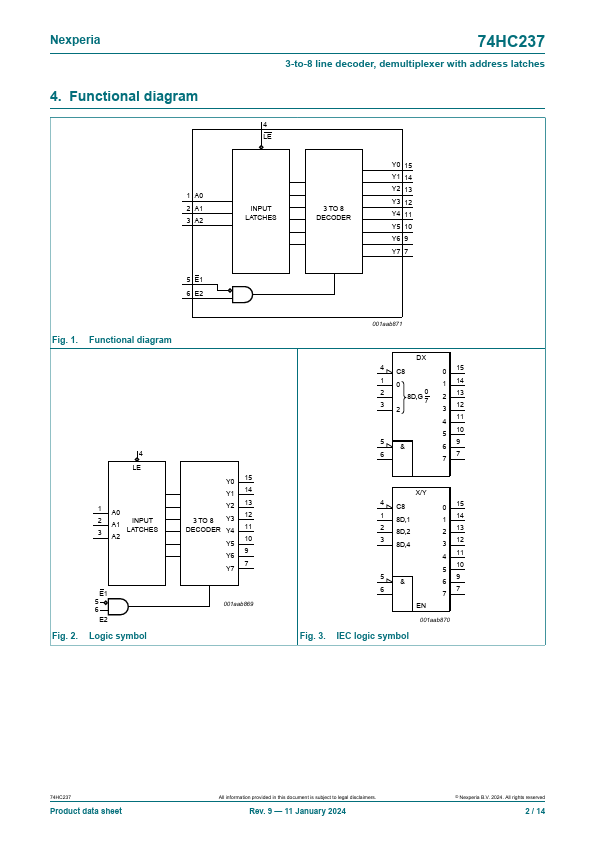
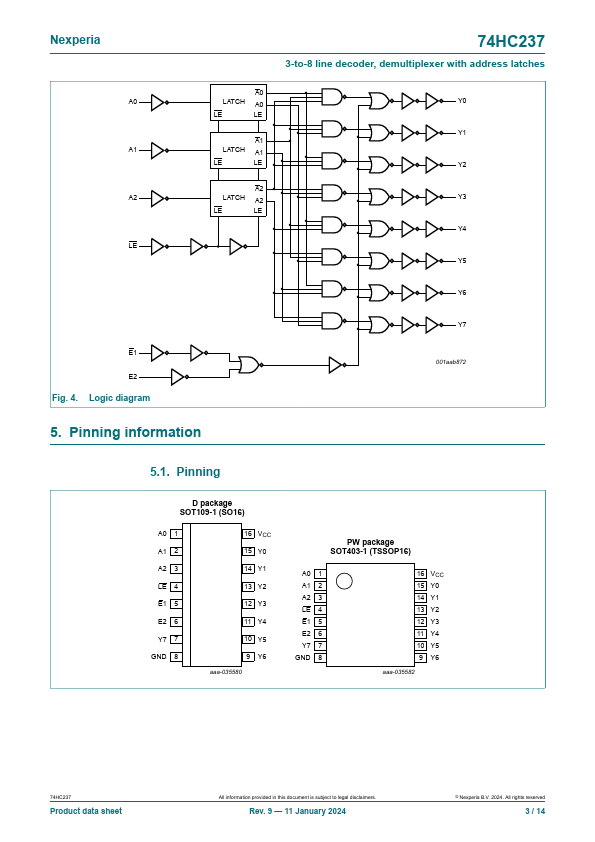
The 74HC237 is a 3-to-8 line decoder, demultiplexer with latches at the three address inputs (An).
The 74HC237 essentially combines the 3-to-8 decoder function with a 3-bit storage latch.
When the latch is enabled (LE = LOW), the 74HC237 acts as a 3-to-8 active LOW decoder.
| Part number | 74HC237D |
|---|---|
| Manufacturer | Nexperia |
| File Size | 258.72 KB |
| Description | 3-to-8 line decoder/demultiplexer |
| Datasheet |
74HC237D Datasheet
|
|
|
|
| Part Number | Description | Manufacturer |
|---|---|---|
| 74HC237D | 3-to-8 Line Decoder/Latch | Toshiba |
| 74HC237 | 3-to-8 line decoder/demultiplexer | Philips |
| 74HC238 | 3-to-8 line decoder/demultiplexer | Philips |
| 74HC238D | 3-to-8 Line Decoder | Toshiba |
| 74HC20 | Dual 4-input NAND gate | Philips |
| Part Number | Description |
|---|---|
| 74HC237 | 3-to-8 line decoder/demultiplexer |
| 74HC237-Q100 | 3-to-8 line decoder/demultiplexer |
| 74HC238 | 3-to-8 line decoder/demultiplexer |
| 74HC238-Q100 | 3-to-8 line decoder/demultiplexer |
| 74HC238D | 3-to-8 line decoder/demultiplexer |
The following content is an automatically extracted verbatim text from the original manufacturer datasheet and is provided for reference purposes only.