Datasheet4U Logo Datasheet4U.com

NXV65HR82DZ2 - DC-DC Converter

Download the NXV65HR82DZ2 datasheet PDF. This datasheet also covers the NXV65HR82DS1 variant, as both devices belong to the same dc-dc converter family and are provided as variant models within a single manufacturer datasheet.

General Description

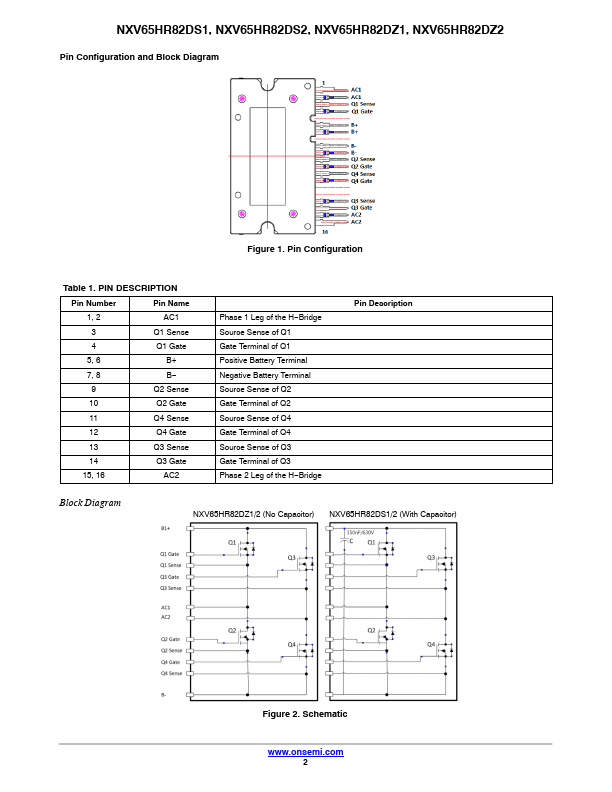
Pin Number Pin Name 1, 2 AC1 3 Q1 Sense 4 Q1 Gate 5, 6 B+ 7, 8 B 9 Q2 Sense 10 Q2 Gate 11 Q4 Sense 12 Q4 Gate 13 Q3 Sense 14 Q3 Gate 15, 16 AC2 Phase 1 Leg of the H Bridge Source Sense of Q1 Gate Terminal of Q1 Positive Battery Terminal Negative Battery Te

Key Features

  • SIP or DIP H.
  • Bridge Power Module for On.
  • board Charger (OBC) in EV or PHEV.
  • 5 kV/1 s Electrically Isolated Substrate for Easy Assembly.
  • Creepage and Clearance per IEC60664.
  • 1, IEC 60950.
  • 1.
  • Compact Design for Low Total Module Resistance.
  • Module Serialization for Full Traceability.
  • Lead Free, RoHS and UL94V.
  • 0 Compliant.
  • Automotive Qualified per AEC Q101 and AQG324 Guidelines.

📥 Download Datasheet

Note: The manufacturer provides a single datasheet file (NXV65HR82DS1-ONSemiconductor.pdf) that lists specifications for multiple related part numbers.

Full PDF Text Transcription (Reference)

The following content is an automatically extracted verbatim text from the original manufacturer datasheet and is provided for reference purposes only.

View original datasheet text
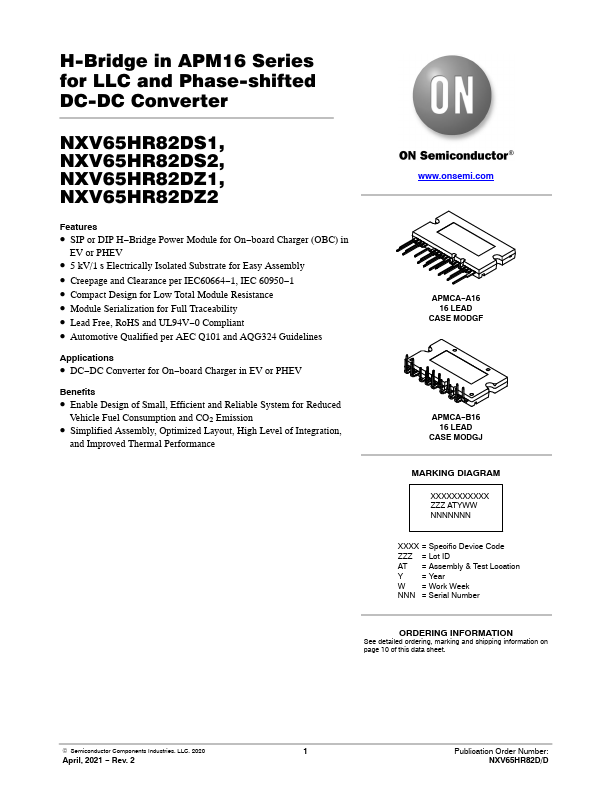
H-Bridge in APM16 Series for LLC and Phase-shifted DC-DC Converter NXV65HR82DS1, NXV65HR82DS2, NXV65HR82DZ1, NXV65HR82DZ2 Features • SIP or DIP H−Bridge Power Module for On−board Charger (OBC) in EV or PHEV • 5 kV/1 s Electrically Isolated Substrate for Easy Assembly • Creepage and Clearance per IEC60664−1, IEC 60950−1 • Compact Design for Low Total Module Resistance • Module Serialization for Full Traceability • Lead Free, RoHS and UL94V−0 Compliant • Automotive Qualified per AEC Q101 and AQG324 Guidelines Applications • DC−DC Converter for On−board Charger in EV or PHEV Benefits • Enable Design of Small, Efficient and Reliable System for Reduced Vehicle Fuel Consumption and CO2 Emission • Simplified Assembly, Optimized Layout, High Level of Integration, and Improved Thermal Performance