
Datasheet Details
| Part number | FAN3217 |
|---|---|
| Manufacturer | onsemi |
| File Size | 954.50 KB |
| Description | Low-Side Gate Drivers |
| Datasheet |
 FAN3217 Datasheet FAN3217 Datasheet
|
|
|

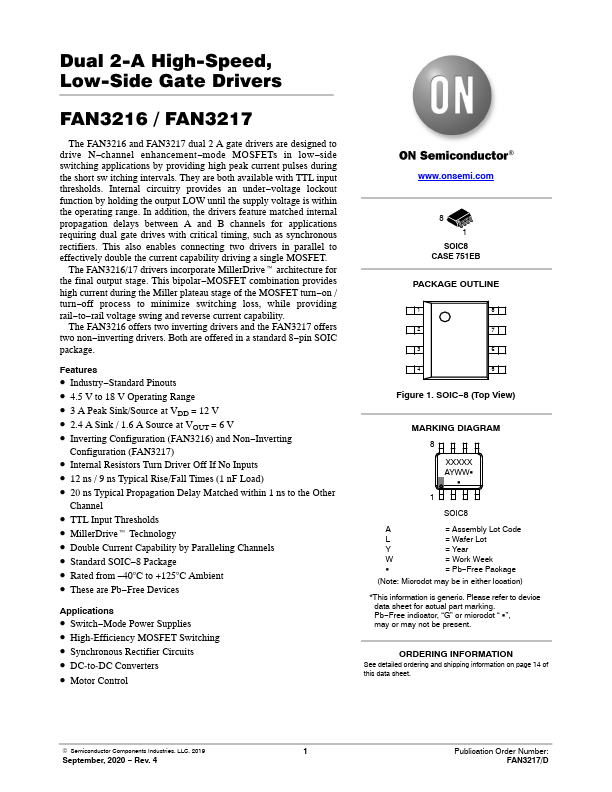
Download the FAN3217 datasheet PDF. This datasheet also covers the FAN3216 variant, as both devices belong to the same low-side gate drivers family and are provided as variant models within a single manufacturer datasheet.
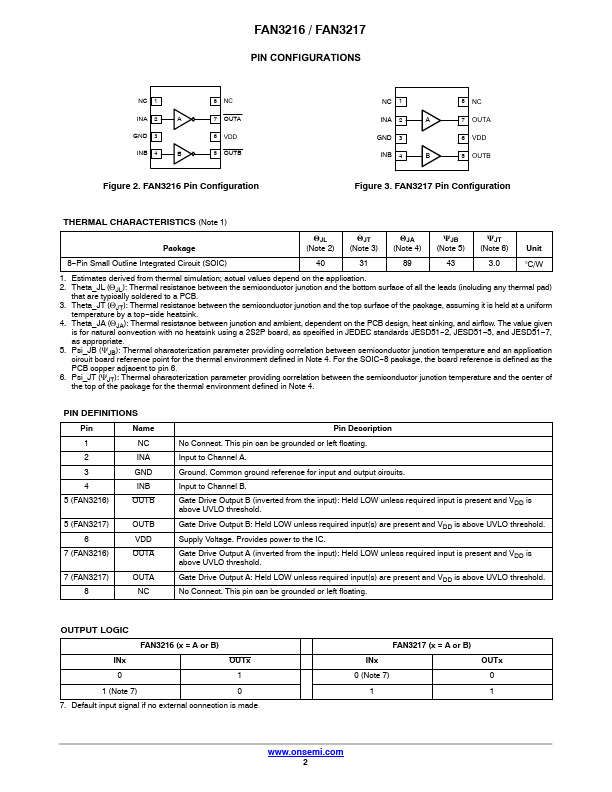
No Connect.
This pin can be grounded or left floating.
Input to Channel A.
| Part number | FAN3217 |
|---|---|
| Manufacturer | onsemi |
| File Size | 954.50 KB |
| Description | Low-Side Gate Drivers |
| Datasheet |
FAN3217 Datasheet
|
|
|
|
| Part Number | Description | Manufacturer |
|---|---|---|
| FAN3223 | Low-Side Gate Drivers | Fairchild Semiconductor |
| FAN3224 | Low-Side Gate Drivers | Fairchild Semiconductor |
| FAN3225 | Low-Side Gate Drivers | Fairchild Semiconductor |
| FAN3226 | Low-Side Gate Drivers | Fairchild Semiconductor |
| FAN3227 | Low-Side Gate Drivers | Fairchild Semiconductor |
| Part Number | Description |
|---|---|
| FAN3213 | Low-Side Gate Drivers |
| FAN3214 | Low-Side Gate Drivers |
| FAN3216 | Low-Side Gate Drivers |
| FAN3223 | Dual 4-A High-Speed Low-Side Gate Drivers |
| FAN3224 | Dual 4-A High-Speed Low-Side Gate Drivers |
The following content is an automatically extracted verbatim text from the original manufacturer datasheet and is provided for reference purposes only.