
Datasheet Details
| Part number | P3T2030BUK |
|---|---|
| Manufacturer | NXP Semiconductors |
| File Size | 703.56 KB |
| Description | digital temperature sensor |
| Datasheet |
 P3T2030BUK Datasheet P3T2030BUK Datasheet
|
|
|

Download the P3T2030BUK datasheet PDF. This datasheet also covers the P3T1035AUK variant, as both devices belong to the same digital temperature sensor family and are provided as variant models within a single manufacturer datasheet.
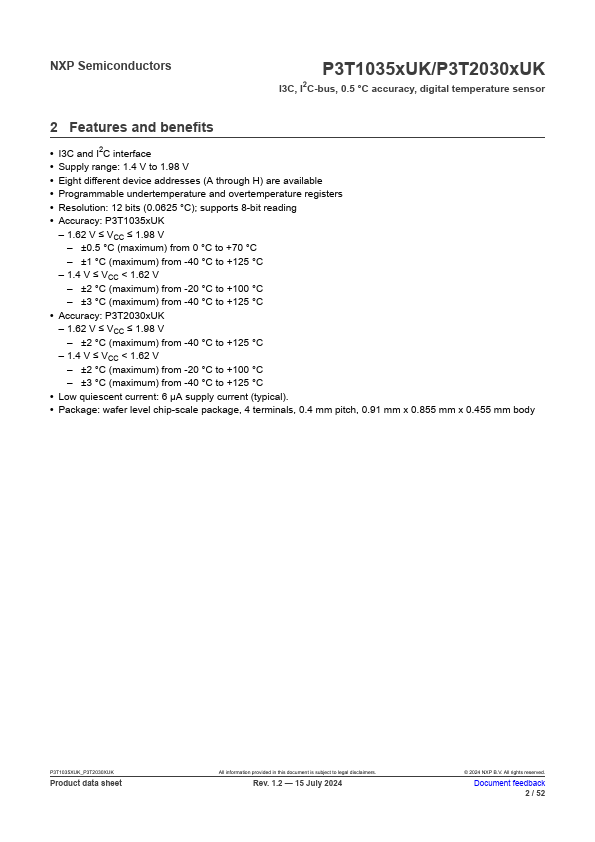
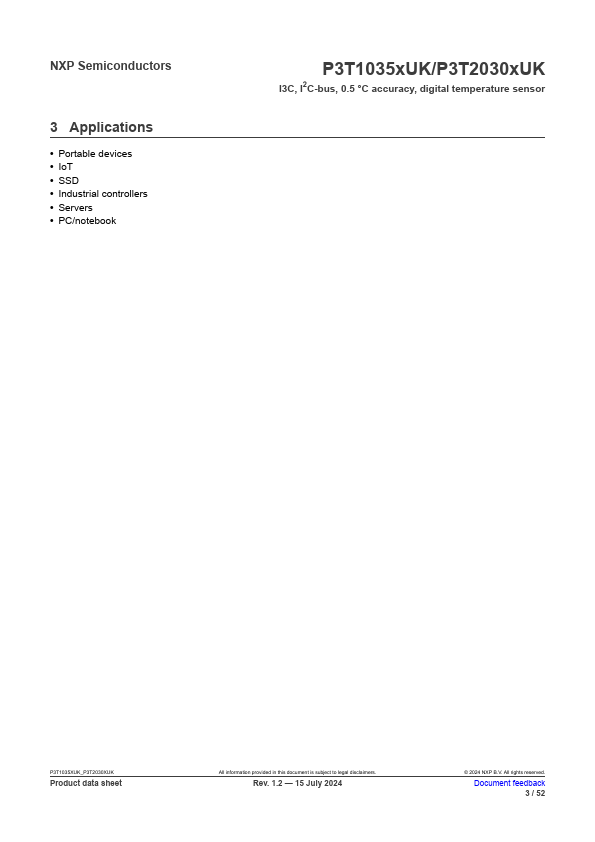
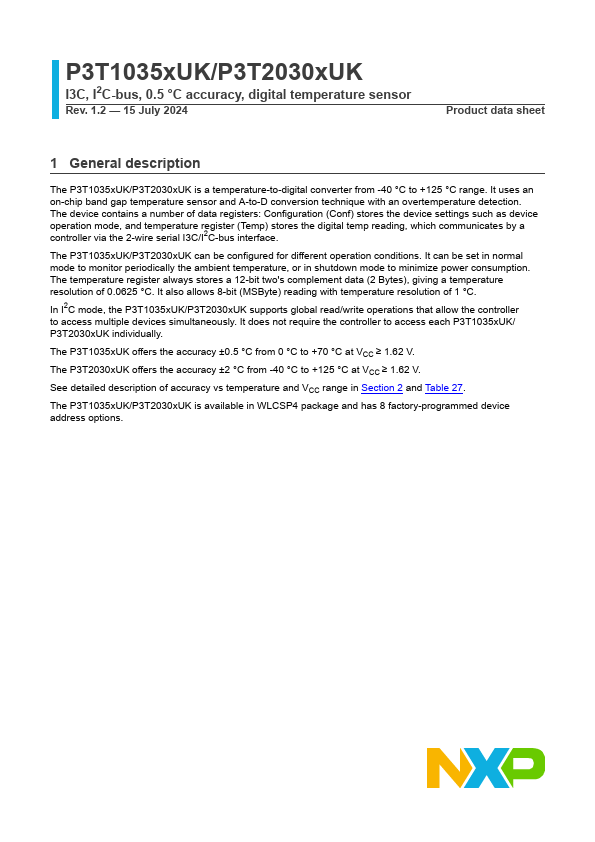
The P3T1035xUK/P3T2030xUK is a temperature-to-digital converter from -40 °C to +125 °C range.
It uses an on-chip band gap temperature sensor and A-to-D conversion technique with an overtemperature detection.
| Part number | P3T2030BUK |
|---|---|
| Manufacturer | NXP Semiconductors |
| File Size | 703.56 KB |
| Description | digital temperature sensor |
| Datasheet |
P3T2030BUK Datasheet
|
|
|
|
| Part Number | Description | Manufacturer |
|---|
| Part Number | Description |
|---|---|
| P3T2030AUK | digital temperature sensor |
| P3T2030CUK | digital temperature sensor |
| P3T2030DUK | digital temperature sensor |
| P3T2030EUK | digital temperature sensor |
| P3T2030FUK | digital temperature sensor |
The following content is an automatically extracted verbatim text from the original manufacturer datasheet and is provided for reference purposes only.