Datasheet4U Logo Datasheet4U.com

NTM88H145S - Tire pressure monitor sensor

Download the NTM88H145S datasheet PDF. This datasheet also covers the NTM88H025S variant, as both devices belong to the same tire pressure monitor sensor family and are provided as variant models within a single manufacturer datasheet.

Description

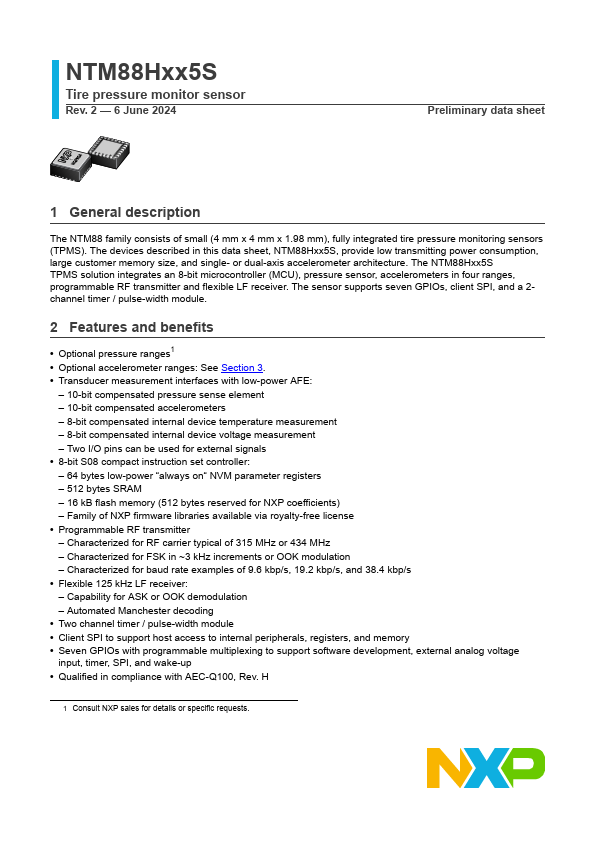
The NTM88 family consists of small (4 mm x 4 mm x 1.98 mm), fully integrated tire pressure monitoring sensors (TPMS).

The devices described in this data sheet, NTM88Hxx5S, provide low transmitting power consumption, large customer memory size, and single- or dual-axis accelerometer architecture.

Features

  • Optional pressure ranges1.
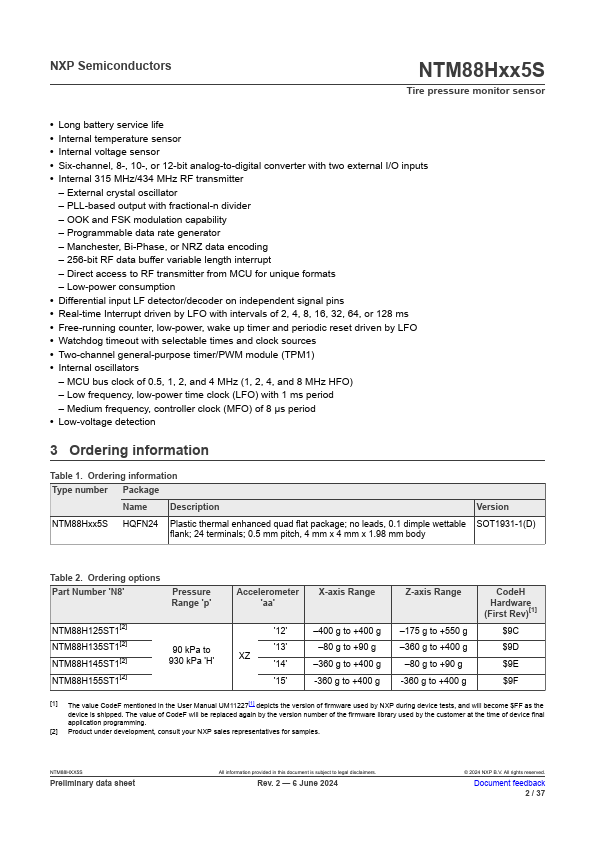
  • Optional accelerometer ranges: See Section 3.
  • Transducer measurement interfaces with low-power AFE:.
  • 10-bit compensated pressure sense element.
  • 10-bit compensated accelerometers.
  • 8-bit compensated internal device temperature measurement.
  • 8-bit compensated internal device voltage measurement.
  • Two I/O pins can be used for external signals.
  • 8-bit S08 compact instruction set controller:.

📥 Download Datasheet

Note: The manufacturer provides a single datasheet file (NTM88H025S-NXP.pdf) that lists specifications for multiple related part numbers.

Full PDF Text Transcription

Click to expand full text
NTM88Hxx5S Tire pressure monitor sensor Rev. 2 — 6 June 2024 Preliminary data sheet 1 General description The NTM88 family consists of small (4 mm x 4 mm x 1.98 mm), fully integrated tire pressure monitoring sensors (TPMS). The devices described in this data sheet, NTM88Hxx5S, provide low transmitting power consumption, large customer memory size, and single- or dual-axis accelerometer architecture. The NTM88Hxx5S TPMS solution integrates an 8-bit microcontroller (MCU), pressure sensor, accelerometers in four ranges, programmable RF transmitter and flexible LF receiver. The sensor supports seven GPIOs, client SPI, and a 2channel timer / pulse-width module. 2 Features and benefits • Optional pressure ranges1 • Optional accelerometer ranges: See Section 3.

Published: |