
Datasheet Details
| Part number | MAX8649A |
|---|---|
| Manufacturer | Maxim Integrated (Analog Devices) |
| File Size | 1.15 MB |
| Description | 1.8A Step-Down Regulator |
| Datasheet |
 MAX8649A Datasheet MAX8649A Datasheet
|
|
|

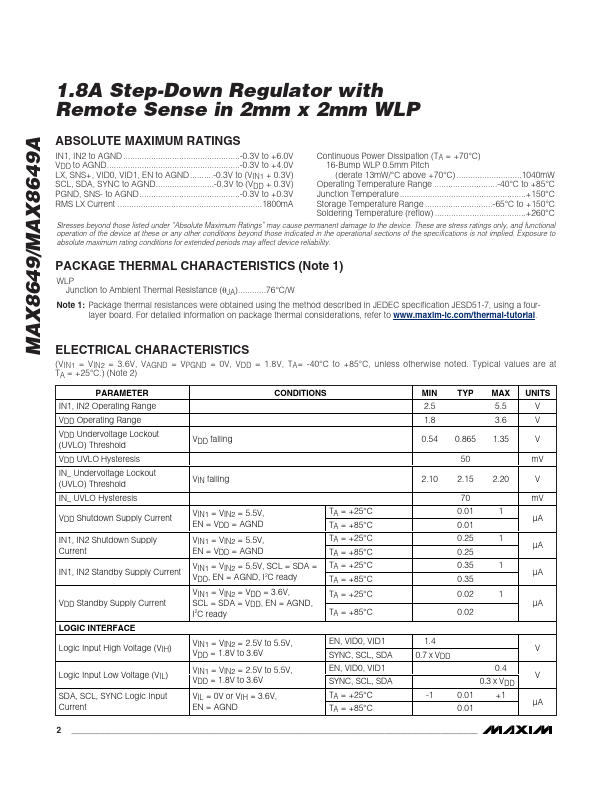
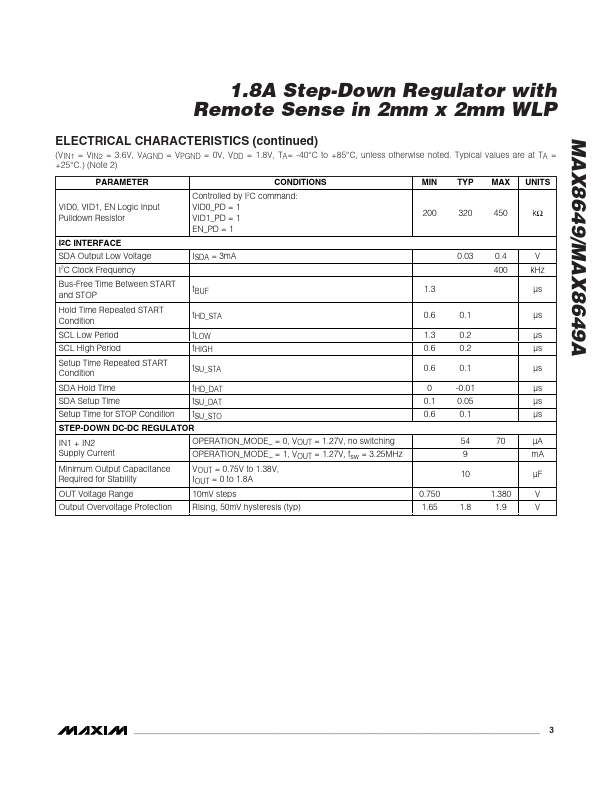
Download the MAX8649A datasheet PDF. This datasheet also covers the MAX8649 variant, as both devices belong to the same 1.8a step-down regulator family and are provided as variant models within a single manufacturer datasheet.
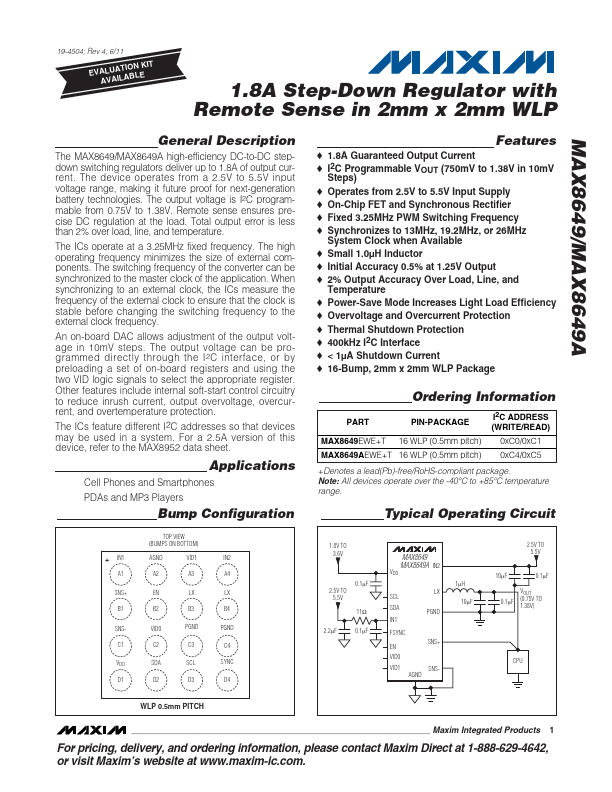
The MAX8649/MAX8649A high-efficiency DC-to-DC stepdown switching regulators deliver up to 1.8A of output current.
The device operates from a 2.5V to 5.5V input voltage range, making it future proof for next-generation battery technologies.
The output voltage is I2C programmable from 0.75V to 1.38V.
| Part number | MAX8649A |
|---|---|
| Manufacturer | Maxim Integrated (Analog Devices) |
| File Size | 1.15 MB |
| Description | 1.8A Step-Down Regulator |
| Datasheet |
MAX8649A Datasheet
|
|
|
|
| Part Number | Description | Manufacturer |
|---|---|---|
| MAX8649 | 1.8A Step-Down Regulator | Maxim Integrated Products |
| MAX864 | Dual-Output Charge Pump with Shutdown | Maxim |
| MAX8640Y | 4MHz/2MHz Synchronous Step-Down DC-DC Converters | Maxim Integrated Products |
| MAX8640Z | 4MHz/2MHz Synchronous Step-Down DC-DC Converters | Maxim Integrated Products |
| MAX8643 | 2MHz Step-Down Regulator | Maxim Integrated Products |
| Part Number | Description |
|---|---|
| MAX861 | Switched-Capacitor Voltage Converters |
| MAX86140 | Best-in-Class Optical Pulse Oximeter and Heart-Rate Sensor |
| MAX86141 | Best-in-Class Optical Pulse Oximeter and Heart-Rate Sensor |
| MAX86150 | Integrated Photoplethysmogram and Electrocardiogram Bio-Sensor |
| MAX8671X | PMIC |
The following content is an automatically extracted verbatim text from the original manufacturer datasheet and is provided for reference purposes only.