Datasheet4U Logo Datasheet4U.com

MP2014GZD - Low Quiescent Current Linear Regulator

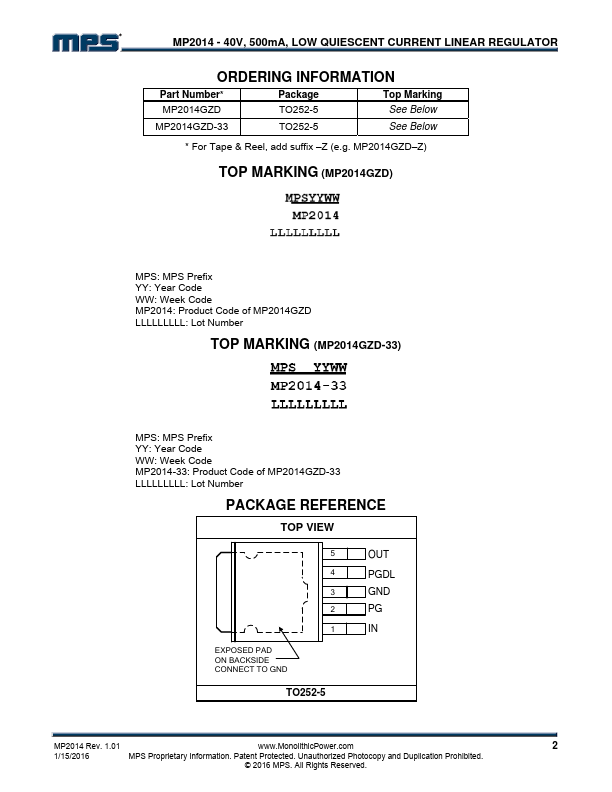
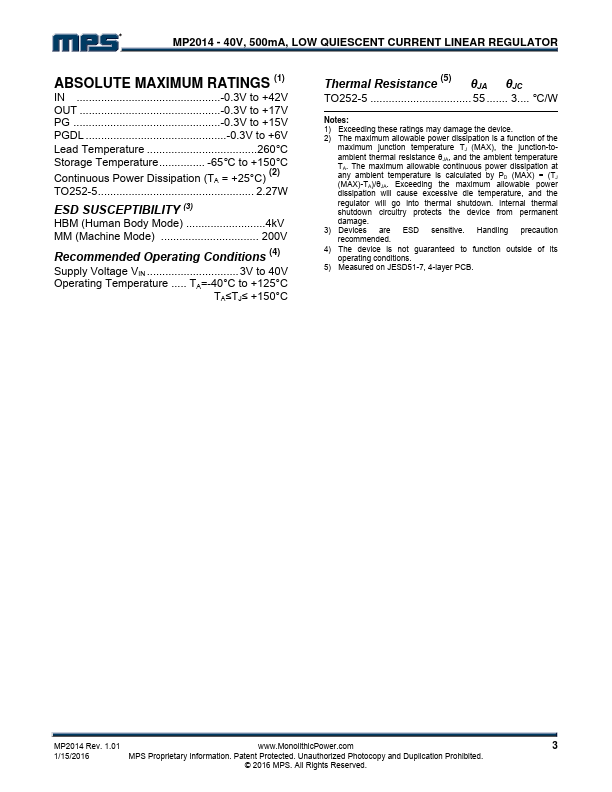
Download the MP2014GZD datasheet PDF (MP2014 included). The manufacturer datasheet provides complete specifications, pinout details, electrical characteristics, and typical applications for low quiescent current linear regulator.

Description

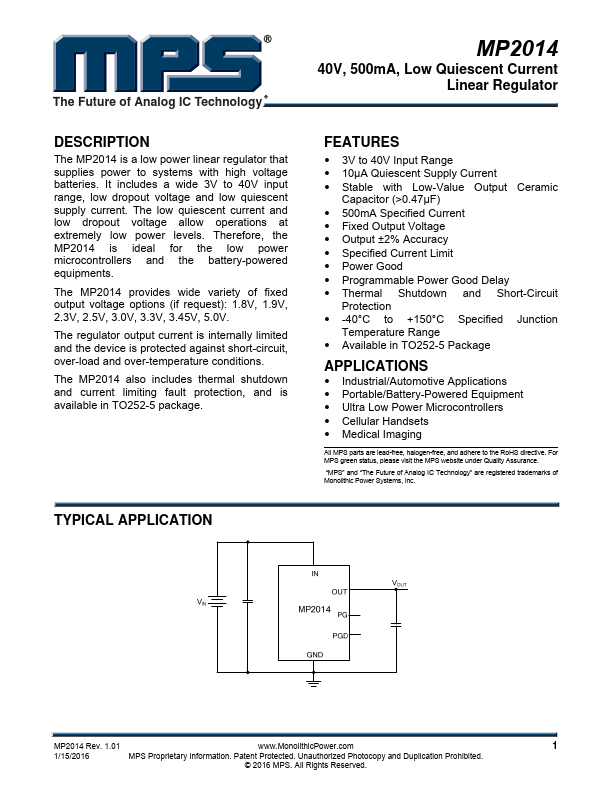
The MP2014 is a low power linear regulator that supplies power to systems with high voltage batteries.

It includes a wide 3V to 40V input range, low dropout voltage and low quiescent supply current.

The low quiescent current and low dropout voltage allow operations at extremely low power levels.

Features

  • 3V to 40V Input Range.
  • 10µA Quiescent Supply Current.
  • Stable with Low-Value Output Ceramic Capacitor (>0.47μF).
  • 500mA Specified Current.
  • Fixed Output Voltage.
  • Output ±2% Accuracy.
  • Specified Current Limit.
  • Power Good.
  • Programmable Power Good Delay.
  • Thermal Shutdown and Short-Circuit Protection.
  • -40°C to +150°C Specified Junction Temperature Range.
  • Available in TO252-5 Package.

📥 Download Datasheet

Note: The manufacturer provides a single datasheet file (MP2014-MPS.pdf) that lists specifications for multiple related part numbers.
Other Datasheets by MPS

Full PDF Text Transcription

Click to expand full text
The Future of Analog IC Technology MP2014 40V, 500mA, Low Quiescent Current Linear Regulator DESCRIPTION The MP2014 is a low power linear regulator that supplies power to systems with high voltage batteries. It includes a wide 3V to 40V input range, low dropout voltage and low quiescent supply current. The low quiescent current and low dropout voltage allow operations at extremely low power levels. Therefore, the MP2014 is ideal for the low power microcontrollers and the battery-powered equipments. The MP2014 provides wide variety of fixed output voltage options (if request): 1.8V, 1.9V, 2.3V, 2.5V, 3.0V, 3.3V, 3.45V, 5.0V. The regulator output current is internally limited and the device is protected against short-circuit, over-load and over-temperature conditions.
Published: |