Datasheet4U Logo Datasheet4U.com

TE5550CN-G - Signal conditioning modules

Download the TE5550CN-G datasheet PDF. This datasheet also covers the TE5540CN variant, as both devices belong to the same signal conditioning modules family and are provided as variant models within a single manufacturer datasheet.

Features

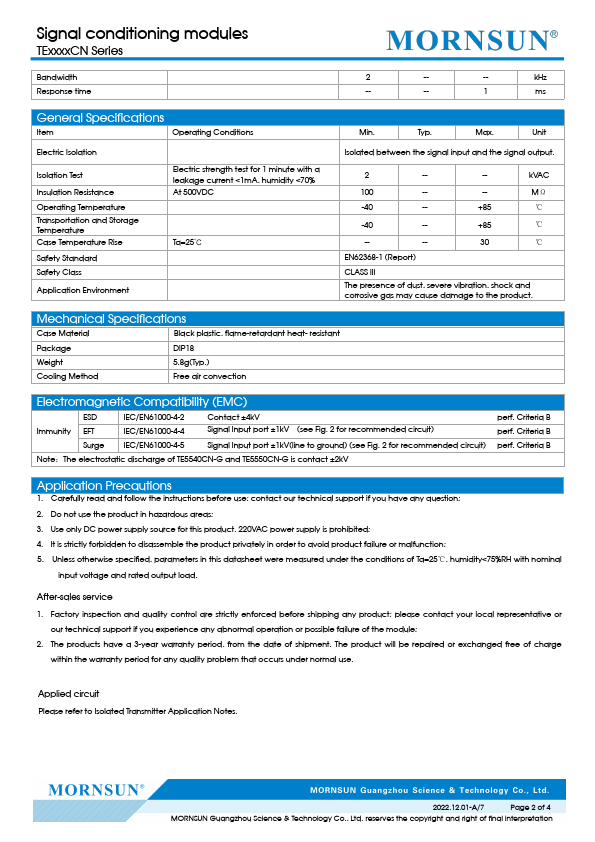
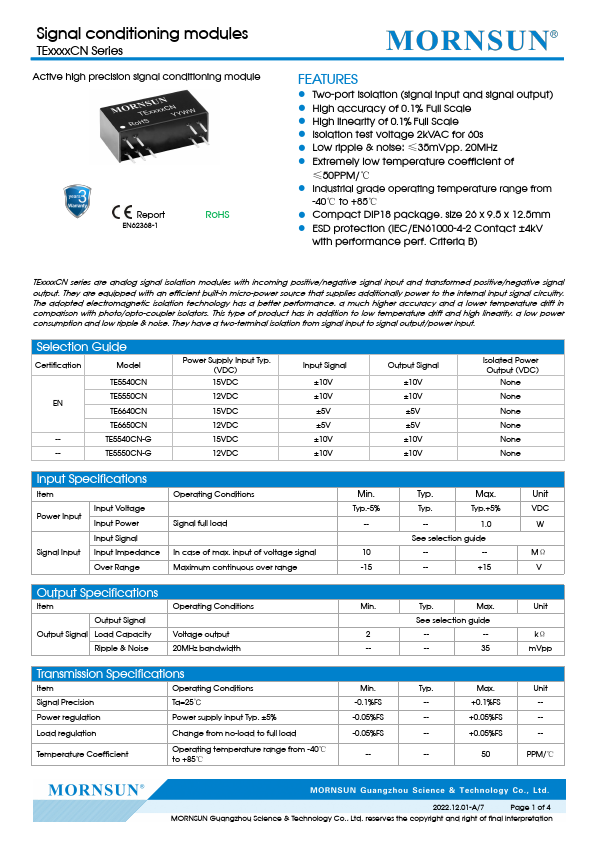
  • Two-port isolation (signal input and signal output).
  • High accuracy of 0.1% Full Scale.
  • High linearity of 0.1% Full Scale.
  • Isolation test voltage 2kVAC for 60s.
  • Low ripple & noise: ≤35mVpp, 20MHz.
  • Extremely low temperature coefficient of ≤50PPM/℃.
  • Industrial grade operating temperature range from -40℃ to +85℃.
  • Compact DIP18 package, size 26 x 9.5 x 12.5mm.
  • ESD protection (IEC/EN61000-4-2 Contact ±4kV with performance perf. Criteria B) TExxxxCN series.

📥 Download Datasheet

Note: The manufacturer provides a single datasheet file (TE5540CN-MORNSUN.pdf) that lists specifications for multiple related part numbers.

Datasheet Details

Part number TE5550CN-G
Manufacturer MORNSUN
File Size 1.28 MB
Description Signal conditioning modules
Datasheet download datasheet TE5550CN-G Datasheet

Full PDF Text Transcription (Reference)

The following content is an automatically extracted verbatim text from the original manufacturer datasheet and is provided for reference purposes only.

View original datasheet text
Signal conditioning modules TExxxxCN Series Active high precision signal conditioning module Report EN62368-1 RoHS FEATURES  Two-port isolation (signal input and signal output)  High accuracy of 0.1% Full Scale  High linearity of 0.1% Full Scale  Isolation test voltage 2kVAC for 60s  Low ripple & noise: ≤35mVpp, 20MHz  Extremely low temperature coefficient of ≤50PPM/℃  Industrial grade operating temperature range from -40℃ to +85℃  Compact DIP18 package, size 26 x 9.5 x 12.5mm  ESD protection (IEC/EN61000-4-2 Contact ±4kV with performance perf. Criteria B) TExxxxCN series are analog signal isolation modules with incoming positive/negative signal input and transformed positive/negative signal output.
Published: |