Datasheet4U Logo Datasheet4U.com

AV9172-01CW16 - Low Skew Output Buffer

Download the AV9172-01CW16 datasheet PDF (AV9 included). The manufacturer datasheet provides complete specifications, pinout details, electrical characteristics, and typical applications for low skew output buffer.

Description

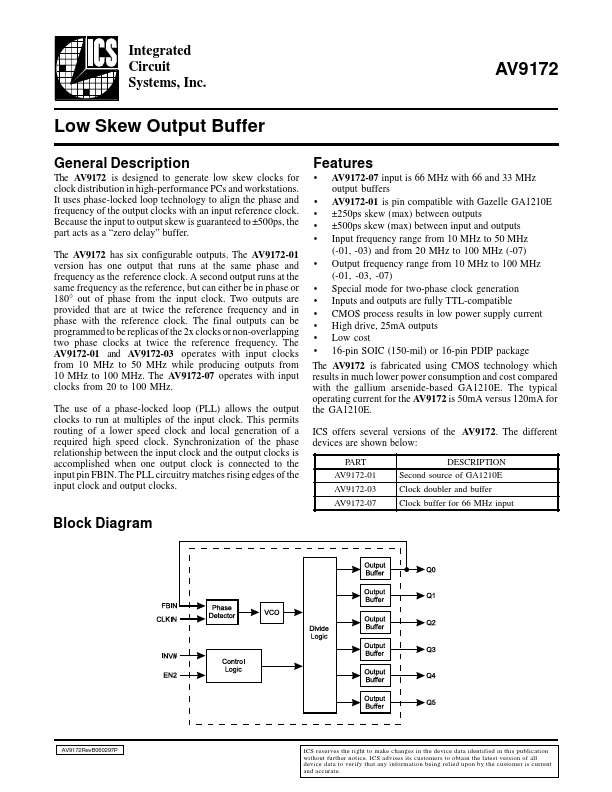
The AV9172 is designed to generate low skew clocks for clock distribution in high-performance PCs and workstations.

It uses phase-locked loop technology to align the phase and frequency of the output clocks with an input reference clock.

Features

  • AV9172-07 input is 66 MHz with 66 and 33 MHz output buffers.
  • AV9172-01 is pin compatible with Gazelle GA1210E.
  • ±250ps skew (max) between outputs.
  • ±500ps skew (max) between input and outputs.
  • Input frequency range from 10 MHz to 50 MHz (-01, -03) and from 20 MHz to 100 MHz (-07).
  • Output frequency range from 10 MHz to 100 MHz (-01, -03, -07).
  • Special mode for two-phase clock generation.
  • Inputs and outputs are fully TTL-compatible.

📥 Download Datasheet

Note: The manufacturer provides a single datasheet file (AV9-172.pdf) that lists specifications for multiple related part numbers.

Datasheet Details

Part number AV9172-01CW16
Manufacturer Integrated Circuit Systems
File Size 399.06 KB
Description Low Skew Output Buffer
Datasheet download datasheet AV9172-01CW16 Datasheet
Other Datasheets by Integrated Circuit Systems

Full PDF Text Transcription

Click to expand full text
Integrated Circuit Systems, Inc. AV9172 Low Skew Output Buffer General Description The AV9172 is designed to generate low skew clocks for clock distribution in high-performance PCs and workstations. It uses phase-locked loop technology to align the phase and frequency of the output clocks with an input reference clock. Because the input to output skew is guaranteed to ±500ps, the part acts as a “zero delay” buffer. The AV9172 has six configurable outputs. The AV9172-01 version has one output that runs at the same phase and frequency as the reference clock. A second output runs at the same frequency as the reference, but can either be in phase or 180° out of phase from the input clock.
Published: |