Datasheet4U Logo Datasheet4U.com

PCMF1USB3C - Common-mode EMI filter

Download the PCMF1USB3C datasheet PDF. This datasheet also covers the PCMF1USB3B variant, as both devices belong to the same common-mode emi filter family and are provided as variant models within a single manufacturer datasheet.

General Description

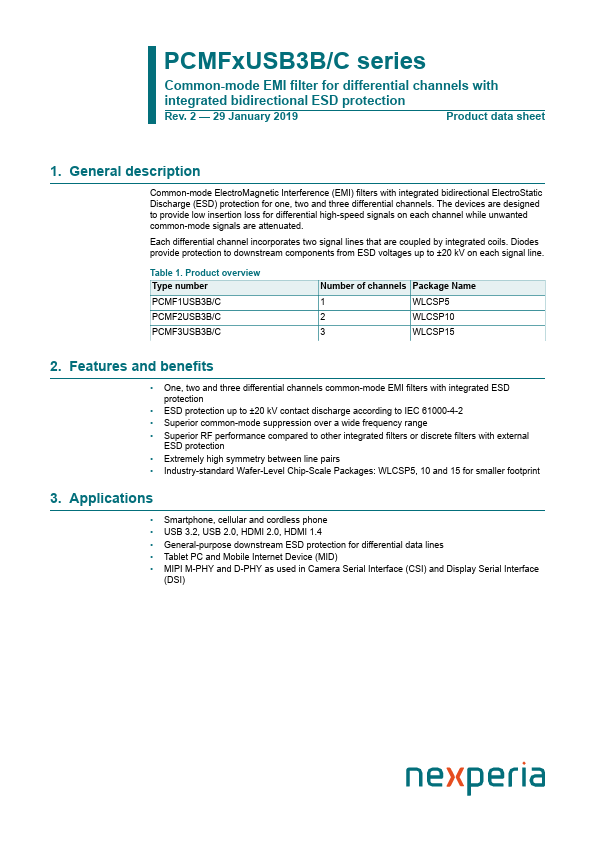
Common-mode ElectroMagnetic Interference (EMI) filters with integrated bidirectional ElectroStatic Discharge (ESD) protection for one, two and three differential channels.

Key Features

  • One, two and three differential channels common-mode EMI filters with integrated ESD protection.
  • ESD protection up to ±20 kV contact discharge according to IEC 61000-4-2.
  • Superior common-mode suppression over a wide frequency range.
  • Superior RF performance compared to other integrated filters or discrete filters with external ESD protection.
  • Extremely high symmetry between line pairs.
  • Industry-standard Wafer-Level Chip-Scale Packages: WLCSP5.

📥 Download Datasheet

Note: The manufacturer provides a single datasheet file (PCMF1USB3B-nexperia.pdf) that lists specifications for multiple related part numbers.

Full PDF Text Transcription (Reference)

The following content is an automatically extracted verbatim text from the original manufacturer datasheet and is provided for reference purposes only.

View original datasheet text
PCMFxUSB3B/C series Common-mode EMI filter for differential channels with integrated bidirectional ESD protection Rev. 2 — 29 January 2019 Product data sheet 1. General description Common-mode ElectroMagnetic Interference (EMI) filters with integrated bidirectional ElectroStatic Discharge (ESD) protection for one, two and three differential channels. The devices are designed to provide low insertion loss for differential high-speed signals on each channel while unwanted common-mode signals are attenuated. Each differential channel incorporates two signal lines that are coupled by integrated coils. Diodes provide protection to downstream components from ESD voltages up to ±20 kV on each signal line. Table 1.