
Datasheet4U Logo Datasheet4U.com

74HC4538D - Dual retriggerable precision monostable multivibrator

Download the 74HC4538D datasheet PDF. This datasheet also covers the 74HC4538 variant, as both devices belong to the same dual retriggerable precision monostable multivibrator family and are provided as variant models within a single manufacturer datasheet.

General Description

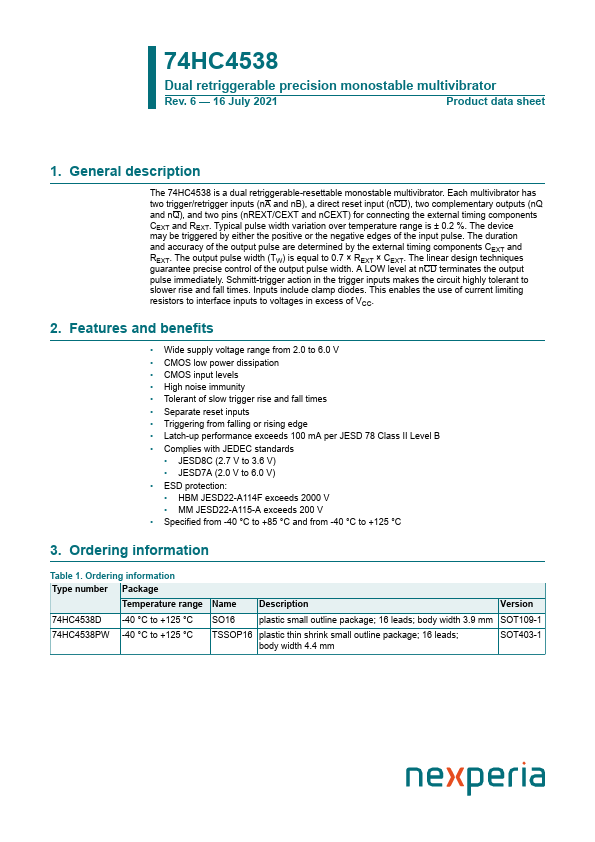
The 74HC4538 is a dual retriggerable-resettable monostable multivibrator.

Key Features

  • Wide supply voltage range from 2.0 to 6.0 V.
  • CMOS low power dissipation.
  • CMOS input levels.
  • High noise immunity.
  • Tolerant of slow trigger rise and fall times.
  • Separate reset inputs.
  • Triggering from falling or rising edge.
  • Latch-up performance exceeds 100 mA per JESD 78 Class II Level B.
  • Complies with JEDEC standards.
  • JESD8C (2.7 V to 3.6 V).
  • JESD7A (2.0 V to 6.0 V).
  • ESD protection:.

📥 Download Datasheet

Note: The manufacturer provides a single datasheet file (74HC4538-nexperia.pdf) that lists specifications for multiple related part numbers.

Datasheet Details

Part number 74HC4538D
Manufacturer Nexperia
File Size 289.12 KB
Description Dual retriggerable precision monostable multivibrator
Datasheet download datasheet 74HC4538D Datasheet

Full PDF Text Transcription (Reference)

The following content is an automatically extracted verbatim text from the original manufacturer datasheet and is provided for reference purposes only.

View original datasheet text
74HC4538 Dual retriggerable precision monostable multivibrator Rev. 6 — 16 July 2021 Product data sheet 1. General description The 74HC4538 is a dual retriggerable-resettable monostable multivibrator. Each multivibrator has two trigger/retrigger inputs (nA and nB), a direct reset input (nCD), two complementary outputs (nQ and nQ), and two pins (nREXT/CEXT and nCEXT) for connecting the external timing components CEXT and REXT. Typical pulse width variation over temperature range is ± 0.2 %. The device may be triggered by either the positive or the negative edges of the input pulse. The duration and accuracy of the output pulse are determined by the external timing components CEXT and REXT. The output pulse width (TW) is equal to 0.7 × REXT × CEXT.