

TRF1500
TRF1500 is DUAL-BAND/DUAL-MODE PCS RECEIVER manufactured by Texas Instruments.
TRF1500 DUAL-BAND/DUAL-MODE PCS RECEIVER
D Low-Noise Amplifier for Each Band D RF Mixer for Each Band With Image
Rejection Configuration for High Band
D IF Amplifier for Both Low and High Bands D Operates From a Supply Voltage Range of
3.6 V to 4 V
SLWS041A
- JANUARY 1998
D Suitable for Portable Dual-Band/Dual-Mode
Cellular Telephones (IS136)
D 48-Pin Plastic Thin Quad Flatpack Package
(TQFP) description
The TRF1500 is a dual-band/dual-mode personal munications system (PCS) receiver for cellular telephones operating dual mode (analog and digital) in the 800-MHz band and single mode (digital) in the 1900-MHz band. The TRF1500 consists of a low-noise amplifier (LNA) and mixer for each band. The high band uses an image rejection mixer for down conversion while the low band relies on an off-chip image rejection filter between the LNA and mixer.
The local oscillator (LO) inputs additionally have buffered outputs that can be used in either single-ended or differential mode for a phase-locked-loop (PLL) configuration. A state is also available that allows the low-band LO to serve as the high-band LO through a mode-selectable frequency doubler.
A wideband mixer is also available for transmit loop architectures monly used in advanced mobile phone systems, global systems for mobile munications, and digital cellular systems.
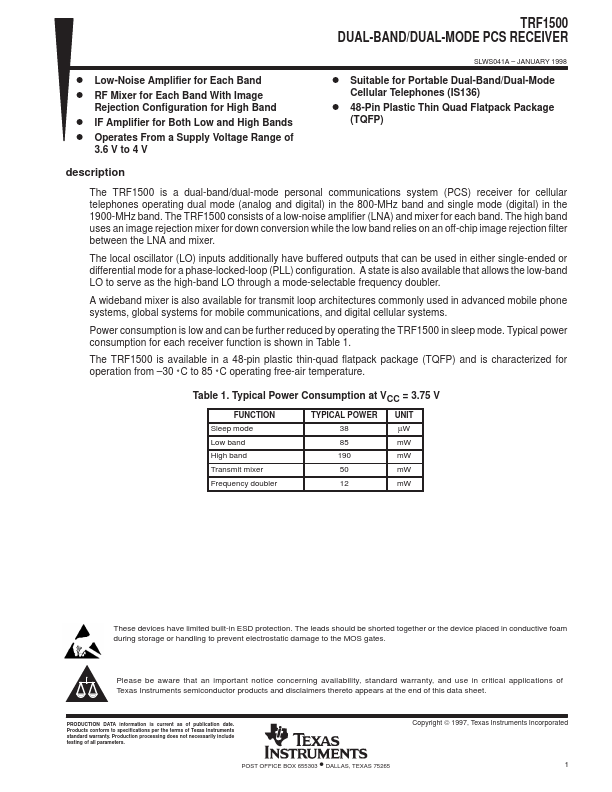
Power consumption is low and can be further reduced by operating the TRF1500 in sleep mode. Typical power consumption for each receiver function is shown in Table 1.
The TRF1500 is available in a 48-pin plastic thin-quad flatpack package (TQFP) and is characterized for operation from
- 30 _C to 85 _C operating free-air temperature.
Table 1. Typical Power Consumption at VCC = 3.75 V
FUNCTION Sleep mode Low band High band Transmit mixer Frequency doubler
TYPICAL POWER 38 85 190 50 12
UNIT µW m W m W m W m W
These devices have limited built-in ESD protection. The leads should be shorted together or the device placed in conductive foam during...