
TL331-Q1
TL331-Q1 is Automotive Single Comparators manufactured by Texas Instruments.
- Part of the TL331B-Q1 comparator family.
- Part of the TL331B-Q1 comparator family.
ures
3 Description
- Qualified for automotive applications
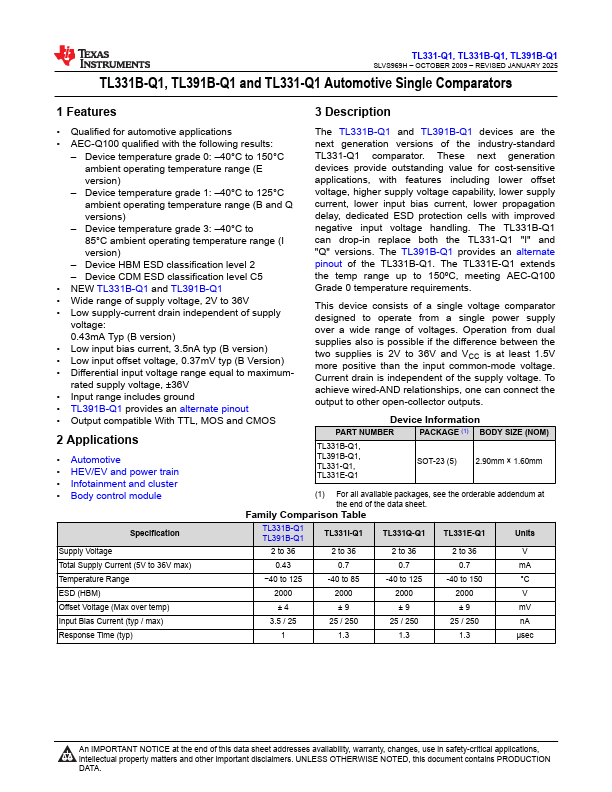
The TL331B-Q1 and TL391B-Q1 devices are the
- AEC-Q100 qualified with the following results: next generation versions of the industry-standard
- Device temperature grade 0:
- 40°C to 150°C
TL331-Q1 parator. These next generation ambient operating temperature range (E devices provide outstanding value for cost-sensitive version) applications, with Features including lower offset
- Device temperature grade 1:
- 40°C to 125°C voltage, higher supply voltage capability, lower supply ambient operating temperature range (B and Q current, lower input bias current, lower propagation versions) delay, dedicated ESD protection cells with improved
- Device temperature grade 3:
- 40°C to negative input voltage handling. The TL331B-Q1
85°C ambient operating temperature range (I can drop-in replace both the TL331-Q1 "I" and version)
"Q" versions. The TL391B-Q1 provides an alternate
- Device HBM ESD classification level 2 pinout of the TL331B-Q1. The TL331E-Q1 extends
- Device CDM ESD classification level C5 the temp range up to 150ºC, meeting AEC-Q100
- NEW TL331B-Q1 and TL391B-Q1
Grade 0 temperature requirements.
- Wide range of supply voltage, 2V to 36V
- Low supply-current drain independent of supply voltage: 0.43m A Typ (B version)
- Low input bias current, 3.5n A typ (B version)
- Low input offset voltage, 0.37m V typ (B Version)
- Differential input voltage range equal to maximumrated supply voltage, ±36V
- Input range includes ground
- TL391B-Q1 provides an alternate pinout
This device consists of a single voltage parator designed to operate from a single power supply over a wide range of voltages. Operation from dual supplies also is possible if the difference between the two supplies is 2V to 36V and VCC is at least 1.5V more positive than the input mon-mode voltage. Current drain is independent of the supply voltage. To achieve wired-AND relationships, one can connect the output to other...