

Datasheet4U Logo Datasheet4U.com

SN75138N - QUADRUPLE BUS TRANSCEIVERS

Download the SN75138N datasheet PDF (SN75138 included). The manufacturer datasheet provides complete specifications, pinout details, electrical characteristics, and typical applications for quadruple bus transceivers.

Description

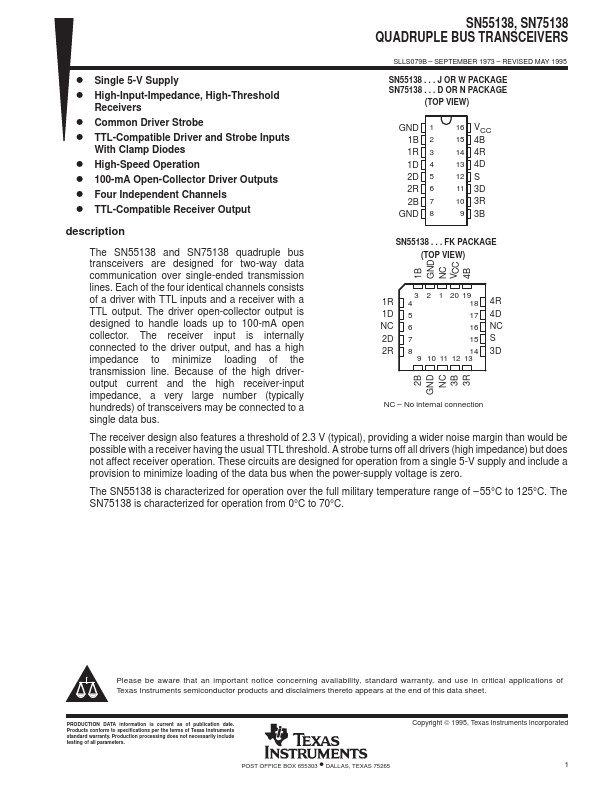
The SN55138 and SN75138 quadruple bus transceivers are designed for two-way data communication over single-ended transmission lines.

Each of the four identical channels consists of a driver with TTL inputs and a receiver with a TTL output.
Features

  • a threshold of 2.3 V (typical), providing a wider noise margin than would be possible with a receiver having the usual TTL threshold. A strobe turns off all drivers (high impedance) but does not affect receiver operation. These circuits are designed for operation from a single 5-V supply and include a provision to minimize loading of the data bus when the power-supply voltage is zero. The SN55138 is characterized for operation over the full military temperature range of.
  • 55°C to 125°C.

📥 Download Datasheet

Note: The manufacturer provides a single datasheet file (SN75138-etcTI.pdf) that lists specifications for multiple related part numbers.
Other Datasheets by Texas Instruments

Full PDF Text Transcription

Click to expand full text
SN55138, SN75138 QUADRUPLE BUS TRANSCEIVERS SLLS079B – SEPTEMBER 1973 – REVISED MAY 1995 D Single 5-V Supply D High-Input-Impedance, High-Threshold Receivers D Common Driver Strobe D TTL-Compatible Driver and Strobe Inputs With Clamp Diodes D High-Speed Operation D 100-mA Open-Collector Driver Outputs D Four Independent Channels D TTL-Compatible Receiver Output SN55138 . . . J OR W PACKAGE SN75138 . . . D OR N PACKAGE (TOP VIEW) GND 1 1B 2 1R 3 1D 4 2D 5 2R 6 2B 7 GND 8 16 VCC 15 4B 14 4R 13 4D 12 S 11 3D 10 3R 9 3B description The SN55138 and SN75138 quadruple bus transceivers are designed for two-way data communication over single-ended transmission lines. Each of the four identical channels consists of a driver with TTL inputs and a receiver with a TTL output.
Published: |