
SN65HVD96
SN65HVD96 is Transceiver manufactured by Texas Instruments.
.ti.
Sym Pol™ Transceiver
Check for Samples: SN65HVD96
SLLSE35B
- JUNE 2010
- REVISED NOVEMBER 2011
Features
- 2 municate Without Errors on Normal or Reversed-Wire Bus Lines
- Up to 5 Mbps Signaling
- Industrial Temperature Range:
- 40°C to 85°C
- Symmetric Polarity Receiver
- Receiver Hysteresis > 100 m V
- Connect up to 32 Nodes Plus Parallel
Terminators on one Bus, or Connect up to 200 Nodes on an Unterminated Bus
- Transient Protection
- ±12 k V Human Body Model on Bus Pins
- ±25 V Repetitive Transient Pulse on Bus Pins
- Additional Reliability Features
:
- Bus Standoff From
- 35 V to 40 V
- Driver Output Short-Circuit Current Limit
- Automatic Thermal Shutdown and Recovery
- plies with ANSI/TIA-4963 Standard
DESCRIPTION
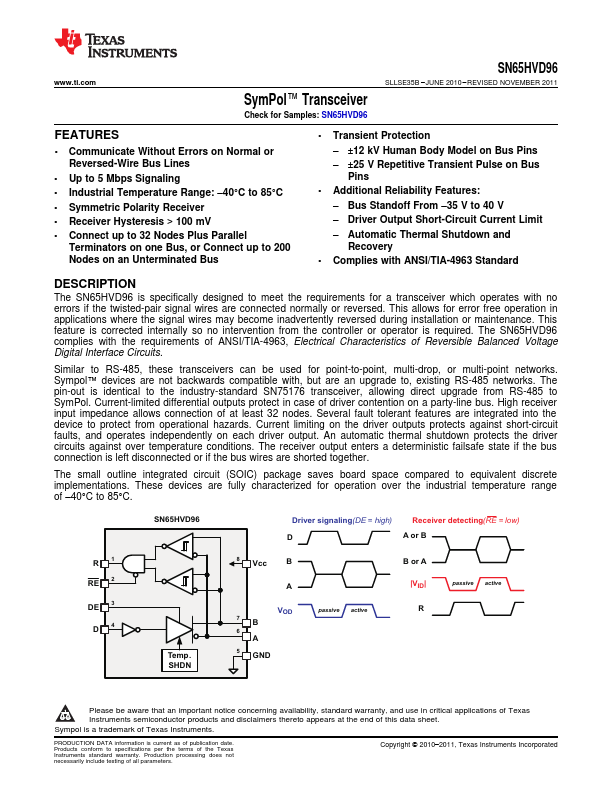
The SN65HVD96 is specifically designed to meet the requirements for a transceiver which operates with no errors if the twisted-pair signal wires are connected normally or reversed. This allows for error free operation in applications where the signal wires may bee inadvertently reversed during installation or maintenance. This feature is corrected internally so no intervention from the controller or operator is required. The SN65HVD96 plies with the requirements of ANSI/TIA-4963, Electrical Characteristics of Reversible Balanced Voltage Digital Interface Circuits.
Similar to RS-485, these transceivers can be used for point-to-point, multi-drop, or multi-point networks. Sympol™ devices are not backwards patible with, but are an upgrade to, existing RS-485 networks. The pin-out is identical to the industry-standard SN75176 transceiver, allowing direct upgrade from RS-485 to Sym Pol. Current-limited differential outputs protect in case of driver contention on a party-line bus. High receiver input impedance allows connection of at least 32 nodes. Several fault tolerant Features are integrated into the device to protect from operational hazards. Current limiting on the driver outputs protects against short-circuit...