• Part: PCA9306-Q1
  • Description: SMBus Voltage-Level Translator
  • Manufacturer: Texas Instruments
  • Size: 1.21 MB
Download PCA9306-Q1 Datasheet PDF
Texas Instruments
PCA9306-Q1
PCA9306-Q1 is SMBus Voltage-Level Translator manufactured by Texas Instruments.
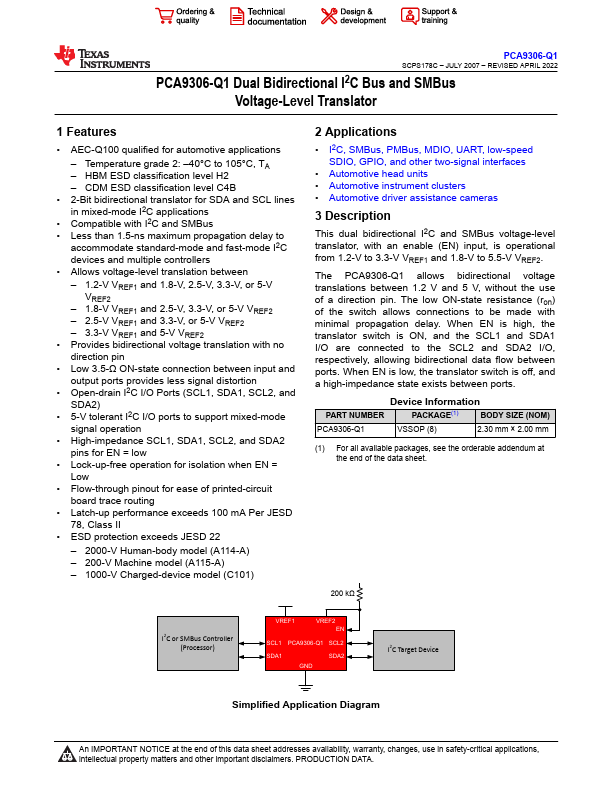
Features - AEC-Q100 qualified for automotive applications - Temperature grade 2: - 40°C to 105°C, TA - HBM ESD classification level H2 - CDM ESD classification level C4B - 2-Bit bidirectional translator for SDA and SCL lines in mixed-mode I2C applications - patible with I2C and SMBus - Less than 1.5-ns maximum propagation delay to acmodate standard-mode and fast-mode I2C devices and multiple controllers - Allows voltage-level translation between - 1.2-V VREF1 and 1.8-V, 2.5-V, 3.3-V, or 5-V VREF2 - 1.8-V VREF1 and 2.5-V, 3.3-V, or 5-V VREF2 - 2.5-V VREF1 and 3.3-V, or 5-V VREF2 - 3.3-V VREF1 and 5-V VREF2 - Provides bidirectional voltage translation with no direction pin - Low 3.5-Ω ON-state connection between input and output ports provides less signal distortion - Open-drain I2C I/O Ports (SCL1, SDA1, SCL2, and SDA2) - 5-V tolerant I2C I/O ports to support mixed-mode signal operation - High-impedance SCL1, SDA1, SCL2, and SDA2 pins for EN = low - Lock-up-free operation for isolation when EN = Low - Flow-through pinout for ease of printed-circuit board trace routing - Latch-up performance exceeds 100 m A Per JESD 78, Class II - ESD protection exceeds JESD 22 - 2000-V Human-body model (A114-A) - 200-V Machine model (A115-A) - 1000-V Charged-device model (C101) 2 Applications - I2C, SMBus, PMBus, MDIO, UART, low-speed SDIO, GPIO, and other two-signal interfaces - Automotive head units - Automotive instrument clusters - Automotive driver assistance cameras 3 Description This dual bidirectional I2C and SMBus voltage-level translator, with an enable (EN) input, is operational from 1.2-V to 3.3-V VREF1 and 1.8-V to 5.5-V VREF2. The PCA9306-Q1 allows bidirectional voltage translations between 1.2 V and 5 V, without the use of a direction pin. The low ON-state resistance (ron) of the switch allows connections to be made with minimal propagation delay. When EN is high, the translator switch is ON, and the SCL1 and SDA1 I/O are connected to the SCL2 and SDA2 I/O,...