MSP50C37
MSP50C37 is MIXED-SIGNAL PROCESSORS manufactured by Texas Instruments.
- Part of the MSP50C32 comparator family.
description
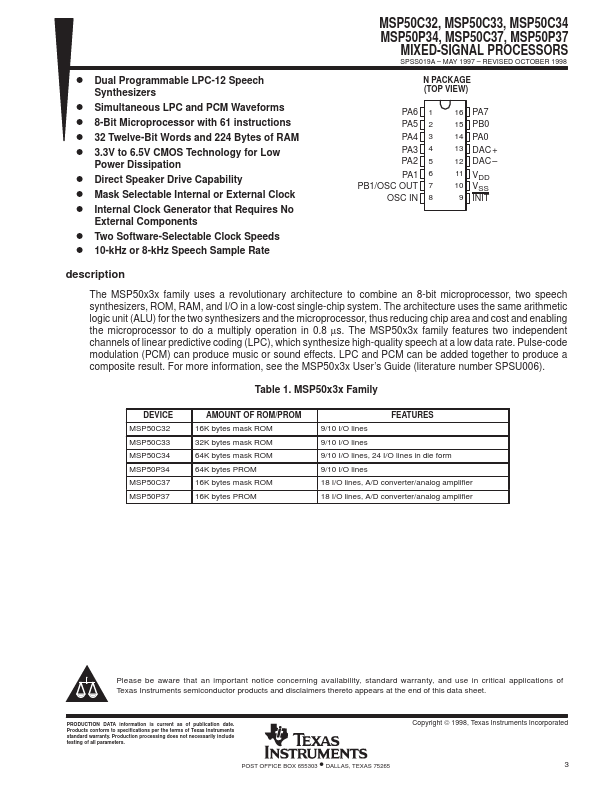
The MSP50x3x family uses a revolutionary architecture to bine an 8-bit microprocessor, two speech synthesizers, ROM, RAM, and I/O in a low-cost single-chip system. The architecture uses the same arithmetic logic unit (ALU) for the two synthesizers and the microprocessor, thus reducing chip area and cost and enabling the microprocessor to do a multiply operation in 0.8 µs. The MSP50x3x family features two independent channels of linear predictive coding (LPC), which synthesize high-quality speech at a low data rate. Pulse-code modulation (PCM) can produce music or sound effects. LPC and PCM can be added together to produce a posite result. For more information, see the MSP50x3x User’s Guide (literature number SPSU006).
Table 1. MSP50x3x Family
DEVICE MSP50C32 MSP50C33 MSP50C34 MSP50P34 MSP50C37 MSP50P37
AMOUNT OF ROM/PROM 16K bytes mask ROM 32K bytes mask ROM 64K bytes mask ROM 64K bytes PROM 16K bytes mask ROM 16K bytes PROM
FEATURES
9/10 I/O lines 9/10 I/O lines 9/10 I/O lines, 24 I/O lines in die form 9/10 I/O lines 18 I/O lines, A/D converter/analog amplifier 18 I/O lines, A/D converter/analog amplifier
Please be aware that an important notice concerning availability, standard warranty, and use in critical applications of Texas Instruments semiconductor products and disclaimers thereto appears at the end of this data sheet.
PRODUCTION DATA information is current as of publication date. Products conform to specifications per the terms of Texas Instruments standard warranty. Production processing does not necessarily include testing of all parameters.
- POST OFFICE BOX 655303 DALLAS, TEXAS 75265
Copyright © 1998, Texas Instruments Incorporated 3
MSP50C32, MSP50C33, MSP50C34 MSP50P34, MSP50C37, MSP50P37 MIXED-SIGNAL PROCESSORS
SPSS019A
- MAY 1997
- REVISED OCTOBER 1998 absolute maximum ratings over operating free-air temperature range†
Supply voltage range, VDD (see Note 1)
- -
- -
- -
- ....